- Quick take
- Yesterday, 10:16
- Hungary
Real wage growth fuels Hungary’s economy
With real wages continuing to grow fast in May, it is difficult to imagine anything other than consumption being the main driver of the Hungarian economy. A tight labour market will influence future wage decisions, but uncertainty surrounding economic – particularly labour-related – policy looms large


| 8.7% |
Average wage growth (May)ING Forecast 9.0% / Previous 9.0% |
The latest average earnings statistics from the Hungarian Central Statistical Office (HCSO) paint a positive picture of wage trends. The data shows an 8.7% year-on-year increase in average gross wages in May 2026. While this represents a slight slowdown compared to the previous month, it is in line with market expectations. Net earnings have grown faster than gross earnings due to changes in family tax credits and benefits for mothers since the beginning of this year.
Median earnings have grown at a slightly faster pace than the minimum wage increase, remaining close to it. This suggests that wage compression persists, particularly in the second and third income quintiles – an issue that companies are seeking to address.
Nominal and real wage growth (% YoY)
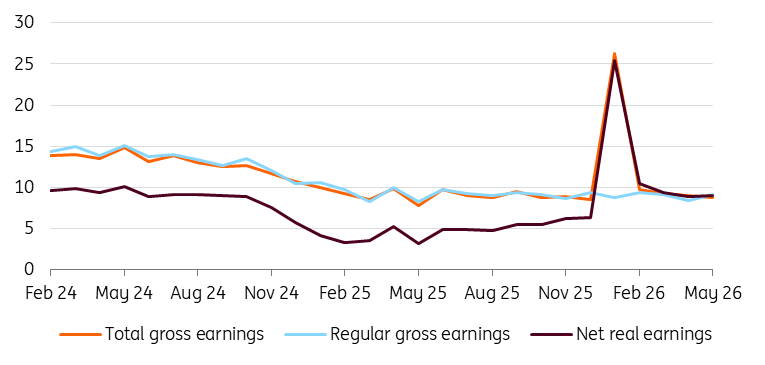
Purchasing power continues to grow dramatically. Amid low inflation and dynamic nominal wage growth, average net real earnings rose by 9% YoY in May. This has substantially raised households’ disposable income, a trend reflected in the consumption data released for the second quarter so far.
Looking at individual sectors, we can observe some interesting fluctuations. Above-average wage growth has been seen in the relatively minor sectors of mining, quarrying and water supply. This can be linked to the government’s wage adjustments at the beginning of the year. In contrast, wage growth in the manufacturing sector remains slightly below average.
In the logistics sector, wages increased by almost 14% on a yearly basis, possibly reflecting an improvement in labour demand and recovery following a period of weakness. The improving outlook for the manufacturing sector is therefore also driving growth in this area. In other areas of the service sector, a familiar pattern is evident: wage growth is mostly around the national average, with education and public administration at the higher end of the scale and healthcare at the lower end.
Wage dynamics (3-month moving average, % YoY)
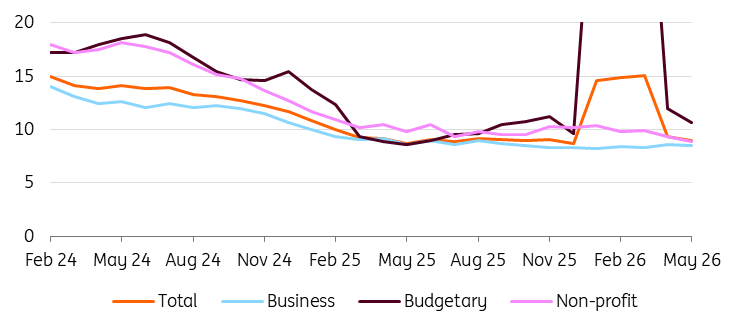
The coming months may be particularly important for wage developments in public administration. This is because salaries have been significantly cut in many areas of this sector. It will be interesting to see what effect this has on the annual wage statistics for the public sector as a whole. Due to pre-election wage adjustments at the beginning of the year, wage growth in this sector was still at 9.4% in May.
The January increases of 11% and 7% in the minimum wage and guaranteed minimum wage, respectively, are clearly having a significant impact on annual wage dynamics in 2026. This is reinforced by the fact that the Hungarian labour market remains tight. Some companies are continuing to hoard labour, which is now an understandable strategy given the improving economic outlook. However, demographic trends are already putting structural pressure on the labour market supply even in the short term, leading to higher wages. The latest data from May did not alter our overall outlook, so we anticipate annual average wage growth of approximately 9-10% for 2026 as a whole.
Since the elections, consumer confidence has improved remarkably, which may encourage companies to be optimistic about future demand trends. However, this has not yet been fully reflected in business confidence indices. This may be partly due to changes in labour import regulations, as well as uncertainty surrounding measures aimed at reducing the budget deficit and the looming minimum wage decisions for the coming year, which have yet to be announced. Geopolitical uncertainty may also be prompting companies to exercise caution.
Content Disclaimer
This publication has been prepared by ING solely for information purposes irrespective of a particular user's means, financial situation or investment objectives. The information does not constitute investment recommendation, and nor is it investment, legal or tax advice or an offer or solicitation to purchase or sell any financial instrument.Read more