- Quick take
- 24 July
- Kazakhstan
Kazakhstan’s central bank keeps surprising as fiscal clarity trumps inflation concerns
The National Bank of Kazakhstan cut rates by 25bp to 16.75%, delivering a second consecutive surprise easing, though on a materially more modest scale. With inflation expectations still elevated, the move seems to signal NBK's growing confidence in fiscal discipline, quasi-fiscal restraint and FX stability


| 16.75% |
NBK base ratea 25 basis point cut |
| Lower than expected | |
Another surprise cut
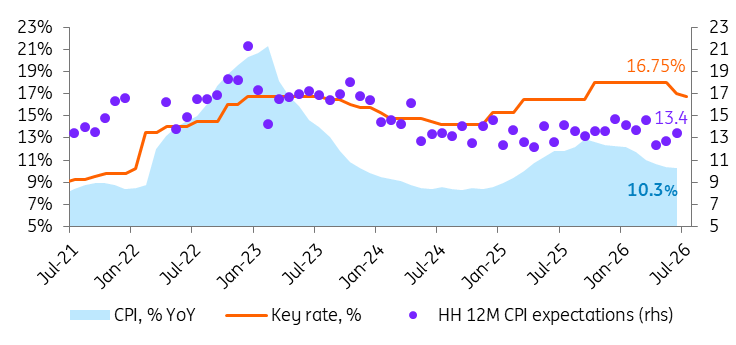
The National Bank of Kazakhstan lowered the base rate from 17.00% to 16.75%, surprising both us and the wider market, as the consensus survey had unanimously expected rates to remain unchanged. The decision follows June's unexpected 100bp cut and marks the second consecutive meeting at which the NBK has eased more aggressively than markets anticipated.
Despite the more modest scale of the cut, the surprise is still notable because the inflation backdrop does not look materially more benign than it did in June. Annual inflation edged down only marginally, from 10.4% to 10.3% year-on-year, while households' inflation expectations rose from 12.7% to 13.4%. Professional forecasters have not improved their inflation forecasts for the next three years.
The NBK Governor Timur Suleimenov indicated during the press conference that it was a close call between a modest cut and a hold decision.
NBK cuts by 25bp as actual CPI shows little deceleration, while households' inflationary expectations pick up again
Kazakhstan CPI, households' 12M CPI expectations, and base rate
Fiscal clarity appears to have tipped the balance
The scale of the cut this time – from 17.00% to 16.75% – is too modest to make a strong impact on the economy, so the main function of the move is rather to send a signal.
The July communication places substantially greater emphasis on fiscal consolidation and agreed limits for quasi-fiscal stimulus. The central bank explicitly notes that future rate decisions depend on compliance with approved budget parameters, National Fund transfers and quasi-fiscal spending plans.
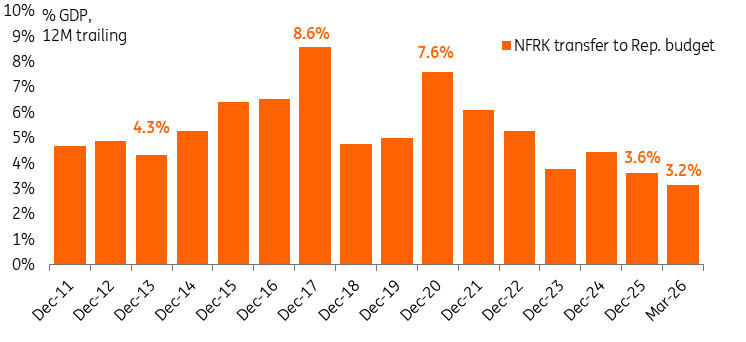
In our view, the primary and direct signal from today's decision is that greater visibility on fiscal and quasi-fiscal policy has boosted the NBK's confidence that inflation can continue moving towards single digits despite still-elevated inflation expectations. The decline in the pro-inflationary risks coming directly from fiscal policy is confirmed by the reduction in the transfers from The National Fund of the Republic of Kazakhstan – the oil fund – to a historical low of 3.2% of GDP in 12 months ending in March 2026, according to our estimates.
Fiscal consolidation is seen through lower appetite for spending the state savings
Transfers from NFRK to the Republican budget
The tenge may be part of the story
A second, less explicit message concerns the exchange rate, in our view.
The NBK again highlighted the stronger tenge as a factor supporting disinflation. That is hardly surprising, given that since 4Q25, the currency has appreciated 16% against the US dollar, helping to contain imported price pressures. High real interest rates and resulting portfolio inflows have likely contributed to that strength.
Against that backdrop, today's cut may also be viewed as an attempt to reduce incentives for speculative inflows. Combined with the recent removal of mandatory FX sales by quasi-sovereigns and greater flexibility in the NBK's foreign-exchange operations, the move is consistent with efforts to reduce overheating risks in the domestic FX market while preserving the tenge's disinflationary contribution.
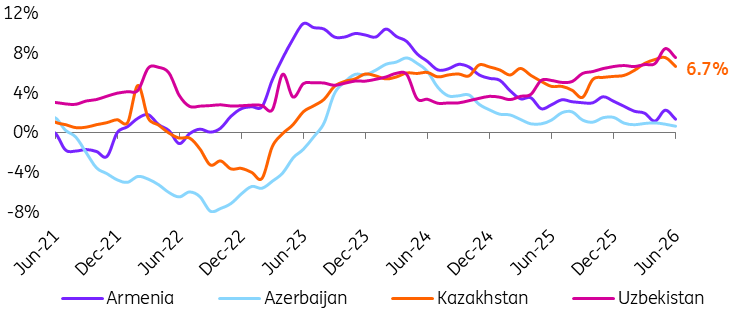
Kazakhstan's real rates are off their peaks but still elevated
CIS-4 policy rates, adjusted for current CPI (% YoY)
The commentary is less dovish than the decision
From a purely inflation-targeting perspective, we note that the statement itself is more cautious than the rate decision.
The NBK acknowledged signs that the disinflationary impulse may be weakening, noted the rise in services inflation, core CPI, household inflation expectations, highlighted strong domestic demand and persistent uncertainties regarding domestic energy prices and regulated tariffs, as well as elevated risks of imported inflation due to volatile global commodity and financial markets.
As a result, the NBK emphasised that future moves are not pre-determined and explicitly stated that pauses – and even a change in the direction of rate decisions – remain possible depending on incoming data.
Overall, the decision was dovish relative to expectations, but the accompanying communication was designed to prevent investors from extrapolating today's cut into a rapid easing cycle.
Room for further cuts exists, but the scale is modest, and timing unclear
We continue to see room for further reductions in the base rate over the medium term. However, we are unsure that this potential can be easily realised in the near-term.
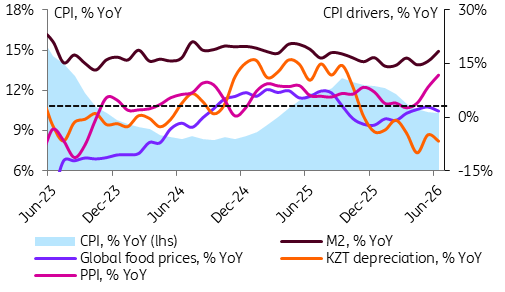
The NBK governor indicated that the decline of the CPI to 9.0–9.5% YoY would be needed to allow the base rate to be cut to 16.00%, and the distance to this scenario remains the key uncertainty. While further disinflation remains our base case for 2027–2028, we look at the rest of 2026 and early 2027 somewhat less optimistically than the NBK. Persistent household inflation expectations, still-strong domestic activity and recent FX volatility amid oil flow disruptions suggest that bringing inflation sustainably into single digits may prove more challenging than policymakers currently envisage.
Global market volatility and strong domestic demand can complicate the return of CPI to single digits
Precursors of Kazakhstan's CPI (% YoY)
Content Disclaimer
This publication has been prepared by ING solely for information purposes irrespective of a particular user's means, financial situation or investment objectives. The information does not constitute investment recommendation, and nor is it investment, legal or tax advice or an offer or solicitation to purchase or sell any financial instrument.Read more