- Quick take
- 24 July
- Hungary
Hungarian labour market’s positive momentum fades
After the pleasant surprise last month, Hungary's June data showed a correction back to the original story: a tight labour market pressured by rising wages and a declining workforce pool. Even considerable optimism won't be enough to change the actual trends in the labour market



| 4.5% |
Unemployment rate (Apr-Jun)ING estimate 4.3%/ Previous 4.3% |
Hungary's unemployment rate increased slightly in June, according to the latest labour market statistics from the Hungarian Central Statistical Office (HCSO). The monthly model estimate puts the rate at 4.4%. Meanwhile, the official three-month moving average survey also increased, once again reaching a rate of 4.5%. Based on these two indicators, it can be concluded that the positive shift seen last month was temporary. The number of unemployed people stood at around 215,000-220,000 in June, which is in line with last year's annual average.
A closer look at the details reveals a stark contrast in the monthly data. While the unemployment rate for men has been steadily declining since the beginning of the year, there has been significant fluctuation for women, with the rate jumping by 0.3ppt month-on-month in June. This has occurred even as employment among women rose. The solution lies in a significant increase in labour force participation. The number of economically active women has reached a peak not seen since October 2025, meaning that a large number have returned to the labour market as jobseekers but have not managed to find employment quickly, in turn increasing the number of unemployed individuals.
In contrast, among men, the number of employed individuals fell, as has the number of inactive individuals, suggesting a significant outflow from the labour market, presumably due to retirement. When examining both men and women, we observed minimal changes within the margin of error in labour market statistics for the total population.
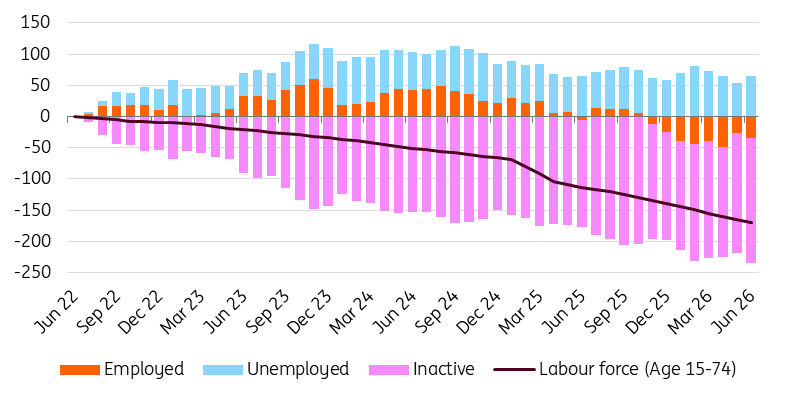
Changes in the labour market since mid-2022 ('000, 3-m moving avg)
Overall, the decline in the working-age population continued (by 5.2k MoM), with approximately 3,000 people disappearing from the active workforce and the rest dropping out of the inactive pool. Alongside a decrease in employment of nearly 8,000, the number of unemployed people increased by 5,000 MoM. According to the latest data, as a result of the population decline, the working-age population is now 170,000 smaller than in mid-2022, when the Hungarian labour market was at its peak.
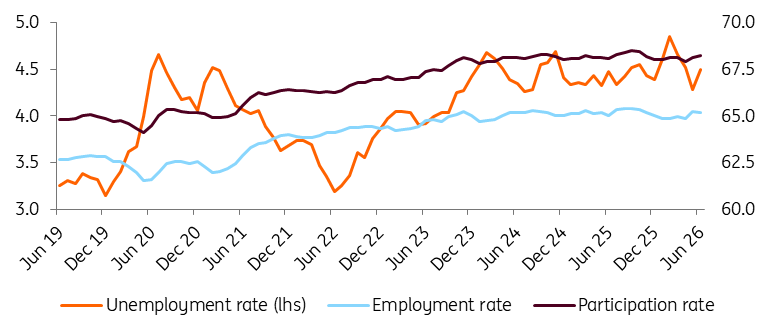
The labour market remains tight, as indicated by the ratios. The positive momentum observed in May proved to be only temporary, as we suspected last month. Nevertheless, significant wage growth coupled with low inflation is substantially increasing households' real disposable income. This has likely contributed significantly to second-quarter economic performance, which is proving stronger than expected. For now, however, no sustained positive change is emerging in the labour market.
Historical trends in the Hungarian labour market (%)
Despite the fact that consumer confidence jumped to an eight-year high in July, geopolitical risks and changes in domestic economic policy continue to limit the rise in business optimism. According to the latest survey, businesses' willingness to hire has declined slightly since June. With the exception of the manufacturing sector, the slight majority of those planning to reduce headcount outnumber those planning to expand. The ramping up of new manufacturing capacity may play a role here, while rising labour costs may force other sectors to streamline operations.
Looking ahead, we do not expect any significant changes to the supply side of the labour market. No demographic shift is on the horizon, so many companies are likely to continue to hoard labour, which will keep the labour market artificially tight. As the end of the year approaches, the issue of next year's wages is also becoming increasingly pressing. The three-year minimum wage agreement settled by the previous government will certainly need revising, and the expected overhaul of the personal income tax system may also create a new situation.
The sooner companies gain clarity on these issues, the sooner new trends in the labour market will begin to emerge. In light of the latest data, we maintain our labour market forecast for this year, which projects an average unemployment rate of around 4.5%.
Content Disclaimer
This publication has been prepared by ING solely for information purposes irrespective of a particular user's means, financial situation or investment objectives. The information does not constitute investment recommendation, and nor is it investment, legal or tax advice or an offer or solicitation to purchase or sell any financial instrument.Read more