CEE: Inflation relief reshapes the rates outlook
- 9 July
- Czech Republic Hungary
Central and Eastern Europe starts the second half of the year with softer inflation and a more dovish rates outlook. Poland has shifted from rate hike fears to speculation about cuts; Czech rates are likely to stay on hold, while Hungary offers the clearest recovery story as inflation eases, allowing the central bank to cut further





Poland: From hikes to cuts?
Inflation prospects have improved markedly in recent weeks, while the growth outlook remains solid. Looking ahead into the second half of the year, we see three key issues to watch:
- A potential dovish twist in the National Bank of Poland's (NBP) monetary policy (a rate cut in 2026 is not our baseline scenario).
- The 2027 budget project before next year's general elections.
- The cumulation of projects financed from Recovery and Resilience Funds (RRF) and its impact on fixed investment.
The surprisingly low inflation reading in May, together with the US-Iran peace deal and the resulting fall in oil prices, shifted market expectations dramatically. At the start of June, markets were pricing in three further rate hikes; they're now pricing in rate cuts. Throughout the entire US-Iran war, we held the view that the NBP would keep rates unchanged. Our baseline scenario still assumes that rates will remain on hold until the end of 2026 as we see CPI slightly above the target of 2.5% year-on-year. But we expect mounting speculation about rate cuts after the summer. In our view, the next move in monetary policy might be a cut, but this is more likely to come in 2027, when we see inflation dropping slightly below target.
At the end of August and beginning of September, investors are likely to focus on the draft bill of the 2027 budget. With general elections scheduled for next year and several fiscal promises from the previous election campaign still undelivered, we do not expect any meaningful fiscal consolidation. At the same time, the sizeable fiscal deficit leaves little room for significant new spending or rate cuts.
The completion of the RRF programme is drawing closer, and the final wave of EU funding should provide a further boost to investment activity. Poland is due to receive a further €8bn from the RRF in September, followed by the final, and largest, payment of €12.6bn in December.
Czech Republic: Modest inflation amid a still sub-potential output
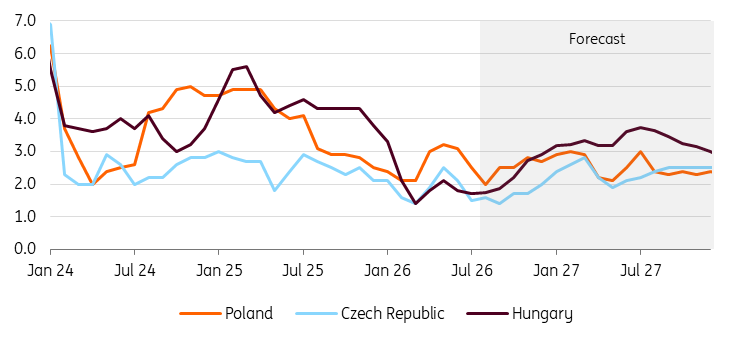
Czech Inflation surprised to the downside in June, mainly due to a sharp drop in food prices, and is set to land below the target this year on average. We do not expect either headline or core inflation to rise significantly over the forecast horizon, despite an anticipated rebound in food prices. Agricultural producer prices are likely to post steady annual growth by year-end and could peak at around 8% in mid-2027. This reflects below-average forecasts for the Czech grain harvest following the exceptional spring drought. After a year of providing little inflationary pressure, food prices are set to become a key driver of inflation over the coming year, pushing headline inflation to an average of 2.5%.
Still, we expect the Czech National Bank to keep policy rates unchanged for quite some time, as the economy is still running below its potential, according to our estimates. In the second half of the year, we believe that the following three things could shape the Czech story:
- The onset of a robust expansion in Czech industry.
- Persistent re-tightening in the labour market.
- A bottoming out of food prices.
All are possible to some extent, but if all three occur, it could herald a structural shift or have implications for monetary policy. Should the economy enter an overheating phase as manufacturing gets into full swing, tighter monetary policy could be warranted to dampen broad inflationary pressures. We are not there yet, but we are travelling in that direction. In any case, real interest rates are set to remain above 1% over the forecast horizon, supporting the koruna. The currency should also benefit from the Czech economy continuing to outperform the eurozone.
Headline inflation forecast (%)
Hungary: Is it time to be optimistic again?
After several challenging years of stagnating GDP, high inflation, and elevated interest rates, it seems that Hungary has finally found a way out of the woods. Negative economic surprises had undermined our faith in the country’s future, but perhaps it is time to become outright optimistic again. The economic activity data for April and May suggest an upside surprise in second-quarter GDP growth. Therefore, we generally acknowledge that there are positive risks surrounding our 1.5% economic activity forecast for 2026.
Despite the energy price shock caused by the blockade of the Strait of Hormuz, Hungarian inflation has proved resilient and defied expectations by declining for the past two months. Against this backdrop, we have revised our inflation forecast for 2026 down to an average of 2.1% and now expect inflation to reach 3% by the end of this year. With our inflation forecast for 2027 cut to 3.3%, our monetary policy outlook has become more dovish.
We expect the National Bank of Hungary to cut the base rate from 6.00% to 5.00% during its upgraded 'midi-cycle'. With lower interest rates and bond yields reducing the attractiveness of carry trades, the forint is unlikely to benefit from significant capital inflows. As a result, exchange rate stability will be crucial in keeping inflation close to 3%, and is likely to limit further rate cuts until late 2027. We then expect a gradual easing cycle to resume, with the policy rate reaching a terminal level of 4.00% by the end of 2028.
Lower inflation, fiscal consolidation and progress towards euro adoption should keep government bond yields on a downward trajectory, which will greatly help to reduce debt servicing costs in the coming years. With this in mind, we do not envisage the fiscal trajectory being an obstacle to euro adoption. The more significant challenge lies with inflation, which will need to fall to 2% despite a buoyant economy and a positive output gap that is likely to generate demand-driven inflationary pressures in the years ahead.
Content Disclaimer
This publication has been prepared by ING solely for information purposes irrespective of a particular user's means, financial situation or investment objectives. The information does not constitute investment recommendation, and nor is it investment, legal or tax advice or an offer or solicitation to purchase or sell any financial instrument.Read more
Authors




Included in the following bundle

ING Monthly: The world economy at half-time
- This bundle contains 14 Articles
Included in the following ING Monthly
ING Monthly: The world economy at half-time