- Quick take
- 28 May
- Hungary
How uncertainty is slowly poisoning the Hungarian labour market
Labour hoarding continues to dominate Hungarian employment trends, with no change expected. Uncertainty is forcing companies into wait-and-see mode, but time is running out. The demographic bomb is ticking and there is no easy way to defuse it



| 4.5% |
Unemployment rate (Feb–Apr)ING estimate 4.6%, previous 4.7% |
The latest labour market statistics from the Hungarian Central Statistical Office (HCSO) show that Hungary's unemployment rate remains unchanged, standing at 4.5% in April 2026 according to the monthly model estimate. Meanwhile, the official three-month moving average moved downwards, falling to 4.5%. Based on these two indicators and following the negative surprise in February, it appears that the labour market is stabilising and there has been no further deterioration. The number of unemployed people is now around 215,000-220,000, which, although lower than in previous months, is still higher than last year's average.
Looking at the details, the monthly data reveals that while the working-age population continued to decline, the number of economically inactive individuals increased significantly (by approximately 25,000). This suggests that, in addition to population decline, a significant number of people have left the labour market. This is also indicated by the fact that – alongside a decline of 27,000 in the number of employed people – the number of unemployed people fell by almost 3,000. Favourable labour market numbers therefore primarily stem from a contraction in both supply and demand.
Changes in the labour market since mid-2022 ('000, 3-m moving avg)
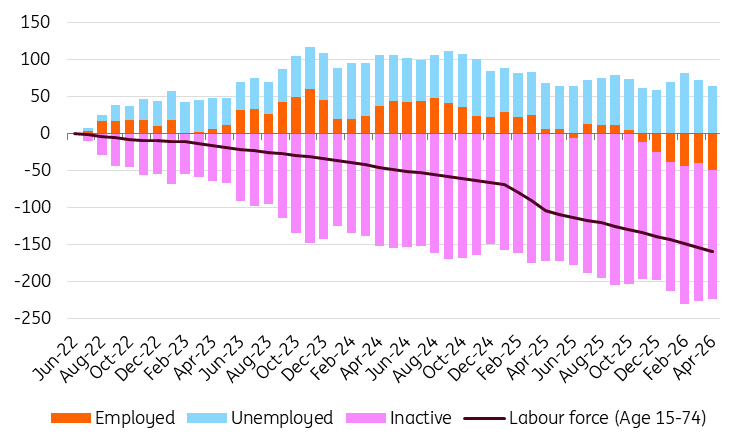
The number of people in employment remains close to a four-and-a-half year low. Compared to the labour market peak in mid-2022 (when the number of unemployed was at a record low), there are now nearly 50,000 fewer people in employment, while the working-age population has shrunk by 160,000. Meanwhile, based on official three-month average data, the number of unemployed people has risen by approximately 65,000.
According to the ratios, the labour market remains fundamentally tight, but a gradual easing is evident. The number of job openings and employment is declining, while the number of unemployed people is rising. Companies remain in a difficult position. Although the economy appears to be picking up finally, rising energy prices and soaring labour costs, as well as geopolitical risk volatility, continue to weigh on business prospects. GKI’s latest business confidence index reflects this trend, having deteriorated slightly in May. The proportion of respondents considering layoffs in the near future is roughly the same as the proportion planning to expand their workforce (both at around 10%). Consequently, most companies are adopting a wait-and-see approach, with some maintaining a labour hoarding approach.
Historical trends in the Hungarian labour market (%)
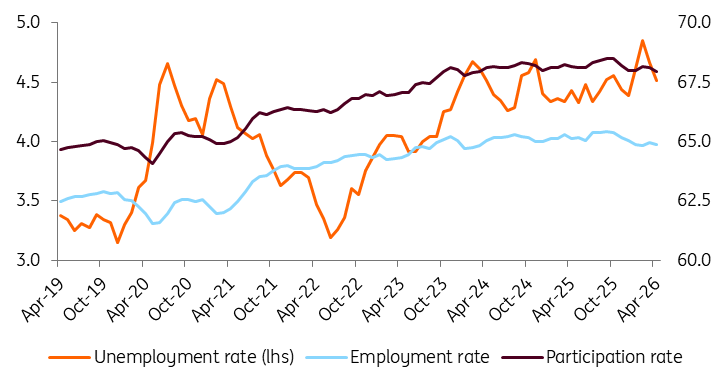
Looking ahead, we do not anticipate any significant changes to the supply side of the labour market. No demographic shifts are expected, while rising labour costs and an uncertain economic outlook could further dampen labour market demand. In the short term, the new government's decision to temporarily ban the import of foreign labour (effective from 1 June) will undoubtedly create further uncertainty. We see this measure as a strong starting point for upcoming coordination between the government and employers.
However, we anticipate some pragmatic compromises in the coming months. In light of the latest data, we're maintaining our labour market forecast for this year and expect the unemployment rate to fluctuate between 4.5% and 5.0%, with the rate likely to be at the midpoint of this range by the end of the year.
Content Disclaimer
This publication has been prepared by ING solely for information purposes irrespective of a particular user's means, financial situation or investment objectives. The information does not constitute investment recommendation, and nor is it investment, legal or tax advice or an offer or solicitation to purchase or sell any financial instrument.Read more