- Quick take
- 12 January
- Hungary
Latest Hungarian industrial numbers crush recovery hopes
Incoming industrial data for November shows that the positive trend of the previous two months was a glitch in the matrix. Performance fell to a new low, diminishing hopes for a positive contribution to GDP growth in the last quarter of 2025



| -5.4% |
Industrial production (YoY, wda)ING estimate: -1.8% / Previous: -2.7% |
Hungarian industrial performance was a major disappointment once again in November. Although there had been monthly growth in the previous two months and BMW's launch of new industrial capacity had raised hopes of another positive performance, this did not materialise. Industrial performance fell by 2% on a monthly basis in November. At the same time, the year-on-year index declined by 5.4%.
The fixed-base index also paints a grim picture: the decline in November completely offset the growth of the previous two months. Production volume is now 8.5% below the 2021 average, reaching a new low. The downward trend in industry has therefore continued.
Volume of industrial production
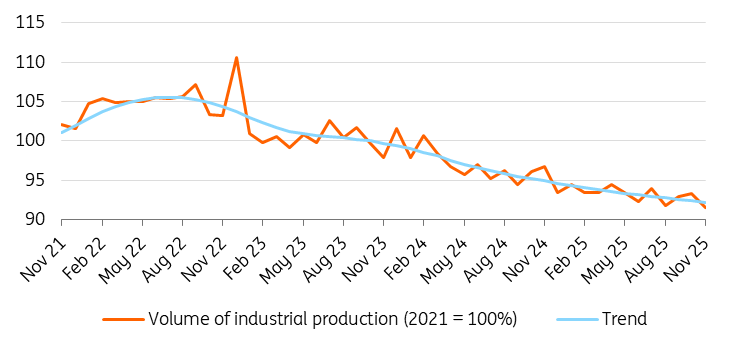
Although detailed data is yet to be released, the overall picture remains unchanged based on preliminary numbers from the Hungarian Central Statistical Office (HCSO), with production declining in most sub-sectors. The electronics industry continues to be the exception and is now, presumably, temporarily joined by the food industry. In contrast, vehicle and electrical equipment manufacturing continued their negative trend.
This clearly shows that one swallow does not make a summer. Despite the start of production at the BMW plant in Debrecen, this has certainly not yet reached a level that would impact the sector's indicators. Naturally, we recognise that ramping up production takes time, but the latest data is still disappointing.
Performance of Hungarian industry
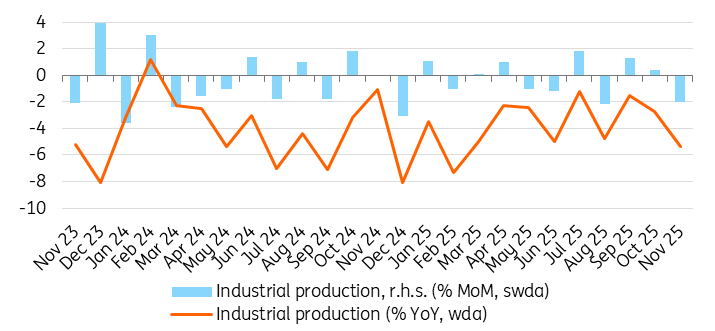
Overall, our cautious optimism based on the past two months has indeed proved to be fragile, as we indicated in our article last month. In general, capacity utilisation did not increase significantly, and most companies continue to complain about a lack of demand and orders. While there are positive signs across Europe that a cyclical upturn in industrial performance has begun, it will take time for this to be reflected in the order books of Hungarian industrial companies and translate into actual performance improvements.
For the time being, therefore, indicators based on domestic surveys, such as the PMI or business confidence index, suggest some kind of treasury optimism rather than reflecting actual performance. Overall, the short-term outlook for local industrial companies producing for export remains gloomy and uncertain, with a cyclical upturn yet to materialise in Hungary.
Manufacturing PMI and industrial production trends
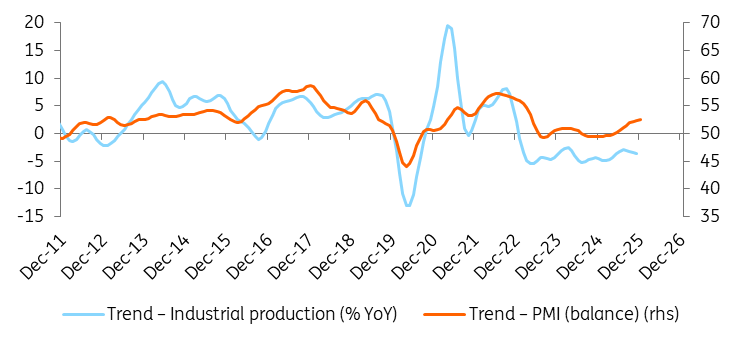
In terms of the outlook for Hungarian GDP in the fourth quarter, the overall picture presented by Friday's retail data and today's industrial data is rather unfavourable. This means that our feelings may be mixed, given the positive data series in October and the negative data series in November. Of course, there is still hope for at least 0.5% average economic growth in 2025, but this would require strong year-end performances from all sectors. Furthermore, an adverse development at the end of 2025 would significantly deteriorate the GDP growth outlook for 2026 (currently expected in the range of 2.0–2.5%) due to the weaker carry-over effect.
Content Disclaimer
This publication has been prepared by ING solely for information purposes irrespective of a particular user's means, financial situation or investment objectives. The information does not constitute investment recommendation, and nor is it investment, legal or tax advice or an offer or solicitation to purchase or sell any financial instrument.Read more