- Quick take
- 29 May
- Japan
Stronger growth in Japan supports June rate hike despite softer inflation
Today's data in Japan was quite surprising. Despite soaring global energy prices, the economy appears to have held up well. Monthly activity data improved quite markedly while inflation decelerated. As growth concerns ease, the Bank of Japan is expected to deliver a June hike


| 1.4% |
Tokyo inflation (%YoY)Core inflation excluding fresh food rose 1.3% |
| Lower than expected | |
Government efforts to curb inflation are clearly bearing fruit
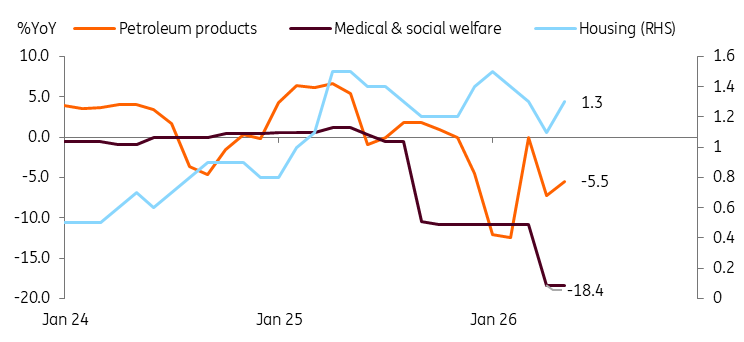
Tokyo inflation unexpectedly eased to 1.4% year-on-year in May (vs 1.5% in April, 1.6% market consensus and ING). The temporary utility fee waiver, gasoline price cap, and reduction of education fees pulled down overall inflation. The deceleration in food prices is related to last year’s high base, triggered by a surge in rice prices. However, service prices continued to rise, with housing up 1.3% and recreation prices up by 1.7%. Thus, we believe that underlying inflation still firmed.
We think the Bank of Japan will likely monitor its new inflation metric “core inflation excluding institutional factors” more closely than conventional inflation readings because the current Japanese inflation data is distorted by several government measures. Also, pipeline prices have risen in the past two months, and this is expected to pass through to consumer prices.
Inflation decelerated mostly due to government interventions
| 0.8% |
Industrial production (%MoM, sa)Retail sales rose 1.3% |
| Higher than expected | |
Monthly activity data was surprisingly robust
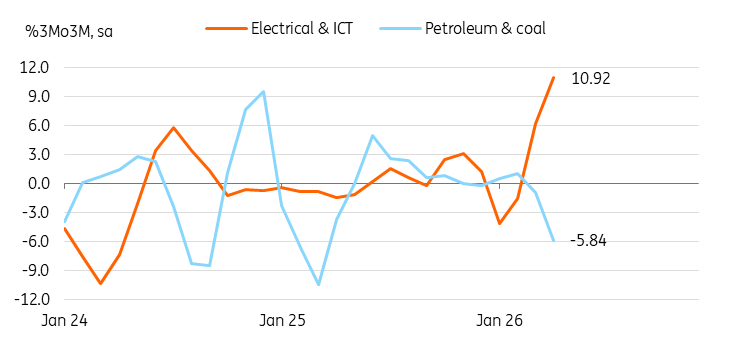
Industrial production unexpectedly rebounded in April. Petrochemical-related output dropped quite sharply, but electrical and information machinery and electronic parts and devices gained solidly. Similar to other major manufacturing economies, Japanese manufacturers also benefited from a strong global chip cycle. However, recent energy supply shocks are denting the petroleum and chemical industries.
Meanwhile, retail sales rose for a second straight month. Looking at the details, fuel sales dropped 4.2%. Gasoline prices have been capped at 1.70 yen per litre, but we believe higher prices have reduced overall fuel consumption. Excluding fuel, other sales rose more strongly. Auto and clothing sales rose quite firmly, by 9.7% and 2.5%, respectively. We believe the government’s various subsidies along with solid wages have supported consumption growth in Japan.
Strong chip demand overshadowed energy shocks
BoJ watch
As the Bank of Japan's policy mandate is to keep inflation sustainably near 2%, soft inflation figures may give more time for the BoJ to wait. However, the economy is showing resilience despite the energy shocks. Wage growth has continued and production and retail sales have improved. Also, real interest rates remain in negative territory, which is the main reason for the weak yen. This is likely to add more inflationary pressure. Thus, we expect the BoJ to raise policy rates in the coming months. We believe June is the most likely timing for the next rate hike.
Content Disclaimer
This publication has been prepared by ING solely for information purposes irrespective of a particular user's means, financial situation or investment objectives. The information does not constitute investment recommendation, and nor is it investment, legal or tax advice or an offer or solicitation to purchase or sell any financial instrument.Read more