- Quick take
- 17 June
- Hungary
Strong wages boost spending in Hungary
April's wage data shows continued growth in line with the minimum wage increase seen earlier this year. Although wage costs for companies are still growing rapidly, there are positive risk factors which could result in the workforce being retained



| 9.0% |
Average wage growth (April)ING Forecast 8.8% / Previous 9.2% |
The latest average earnings statistics from the Hungarian Central Statistical Office (HCSO) paint a positive picture of wage trends. The data show a year-on-year increase of 9.0% in average gross wages in April 2026.
While this represents a slight slowdown compared to the previous month, it is in line with the market consensus. Net earnings are growing faster than gross earnings due to changes in family tax allowances and tax breaks for mothers, which have been in effect since the beginning of this year.
Nominal and real wage growth (% YoY)
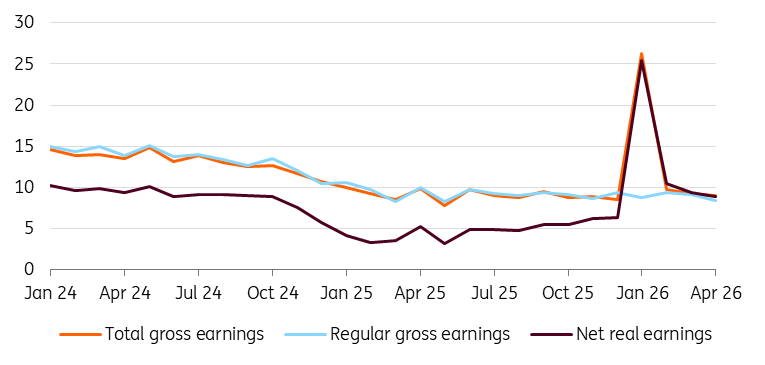
Perhaps even more important than the average wage is the change in the median wage. Here, we continue to see growth of 9.1% and 11.1% on an annual basis for gross and net figures, respectively, which is almost identical to the increase in the minimum wage. This clearly indicates that the increase in the minimum wage caused wage compression, primarily in the second and third-income quintiles. The dataset clearly shows that the companies have been working to address this issue. Wage statistics from the past two months are particularly important because most multinational companies decide on wage changes in spring. Based on what we have seen so far, it appears that these large companies have mostly opted for substantial wage increases.
Looking at the increase in the purchasing power of the average wage, we can see that, due to very low inflation and dynamic income growth, the year-on-year change in net real earnings has remained high at 8.9%. Households’ disposable income is therefore expanding significantly. This trend is clearly reflected in first-quarter retail sales data and the acceleration in consumer spending.
Examining individual sectors reveals some interesting fluctuations. These are likely due to changes in one-off payments and adjustments to their timing. For example, in the mining sector, wages increased sharply in March last year, whereas this year the increase occurred in April. In contrast, one-off payments in the energy industry were made in March this year instead of April last year.
The timing of the elections may have played a role in the latter case, given the strong ties between the energy sector and the government. In manufacturing and construction, wage dynamics mirror those observed in the national economy as a whole, without any outliers. Exceptional growth was observed in the content production sector, with a significant (29% YoY) increase in wages that may be linked to one-off payments tied to the election cycle. The human health and social work activities continued to show the lowest wage growth.
Wage dynamics (3-month moving average, % YoY)
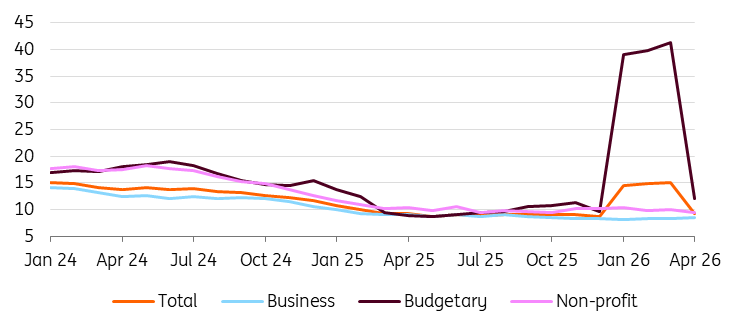
Looking ahead, the 11% and 7% increases to the minimum and guaranteed minimum wages, which came into effect in January, appear to be having a significant impact on annual wage dynamics throughout 2026. This is reinforced by the fact that companies currently engaged in the spring wage-setting cycle have adjusted their earnings policies accordingly. Wage trends continue to be significantly influenced by the fact that a substantial proportion of companies are hoarding labour, while demographic trends are placing structural pressure on the labour market supply side even in the short term.
The latest April data has not altered our overall outlook, so we still expect annual average wage growth of around 9-10% for the whole of 2026. The consumer confidence index, which surged dramatically after the general elections, may give companies cause for optimism regarding a future uptick in demand. A potential end to the war in Iran could also lead to an increase in external growth, which could act as a safeguard against the possibility of layoffs due to poor economic prospects.
Content Disclaimer
This publication has been prepared by ING solely for information purposes irrespective of a particular user's means, financial situation or investment objectives. The information does not constitute investment recommendation, and nor is it investment, legal or tax advice or an offer or solicitation to purchase or sell any financial instrument.Read more