- Quick take
- 5 December 2025
- Romania
Investments take the lead in Romania’s growth picture
We are upgrading our GDP growth estimate to 1.1% in 2025 (versus 0.3% previously), with a short-lived recession likely in the second half of the year as weak consumption offsets some of the investment gains. We maintain a 2026 estimate of 1.4%



The latest GDP figures for the third quarter of the year confirm the flash estimate, with no revisions to previous data. The Romanian economy contracted by 0.2% quarter-on-quarter, while posting 1.6% growth year-on-year. After three quarters, cumulative growth for 2025 stands at 0.8%.
On the demand side, investments were the main growth driver, supported by positive contributions from net exports and consumption. Inventories, however, weighed heavily on growth. From a supply perspective, construction and agriculture led the expansion, while services remained broadly neutral.
Retail sales numbers point to concerning consumption in Q4
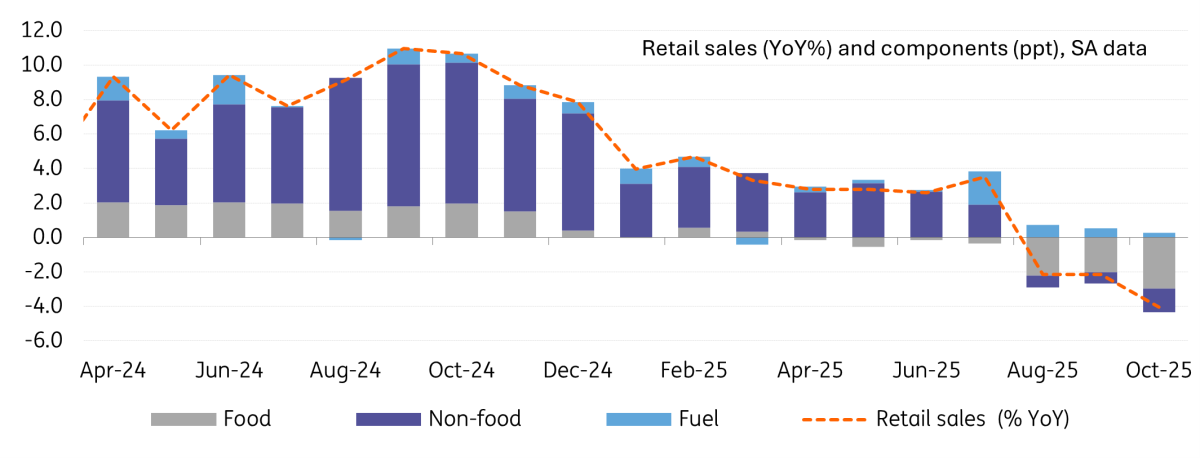
After partially recovering from August’s sharp drop in September, retail activity weakened again in October. Sales fell 1.1% versus the previous month, following a downward revision of the September data as well. This aligns with historically low consumer confidence, suggesting cautious spending will persist in the coming months.
All major categories – food, non-food, and fuels – contracted in October. The largest negative contribution came from food sales, indicating consumers are cutting waste and possibly switching to less premium products. Non-food sales also fell, though this correction was expected after last year’s surge in household goods purchases, supported by rising consumer credit.
Retail sales evolution
What we make of it
Looking ahead, we now expect full-year 2025 GDP growth at 1.1%, which assumes another quarterly contraction in 4Q25. This means that technically, the economy is likely to experience a short-lived recession in the second part of this year. For 2026, we maintain our forecast at 1.4%, with investment remaining the main growth engine, supported by substantial public spending as Romania enters the final year of the RRF programme.
Overall, consumption is likely to remain subdued in early 2026, with a more visible recovery expected in the second half of next year as confidence gradually improves. In the meantime, strong public investment, driven by new infrastructure projects, could help accelerate the rebound. Net exports should have a small positive contribution as the economic slowdown helps rebalance the trade gap.
Content Disclaimer
This publication has been prepared by ING solely for information purposes irrespective of a particular user's means, financial situation or investment objectives. The information does not constitute investment recommendation, and nor is it investment, legal or tax advice or an offer or solicitation to purchase or sell any financial instrument.Read more