- Quick take
- 25 June
- Hungary
Hungary’s labour market still flashing strength
Employment rose more than expected in May, but we see this as a temporary uptick rather than a structural shift, with many firms still hoarding labour



| 4.3% |
Unemployment rate (Mar–May)ING estimate 4.4% / Previous 4.5% |
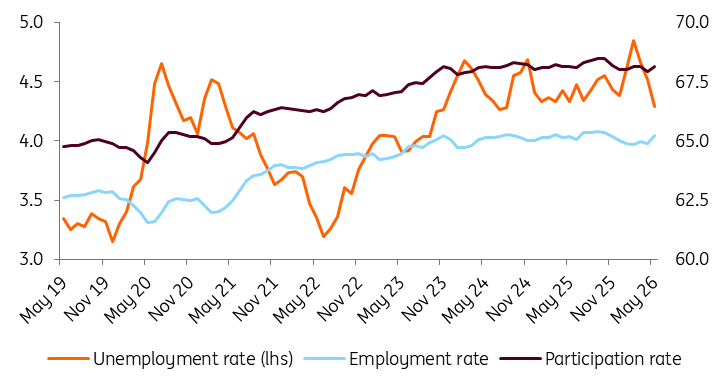
The Hungarian unemployment rate for May came in lower than expected, according to the latest labour market statistics from the Hungarian Central Statistical Office (HCSO). Examining the monthly model estimate, we can see that the unemployment rate fell to 4.3% in May 2026 (from 4.5% in April). Meanwhile, the official three-month moving average survey also declined, falling to 4.3%.
These figures show a significant positive shift in the Hungarian labour market. The number of unemployed people fell below 210,000 in May, which is the lowest figure recorded this year and lower than last year's average. However, we are currently looking at only a single data point, so the sustainability of this shift remains to be seen.
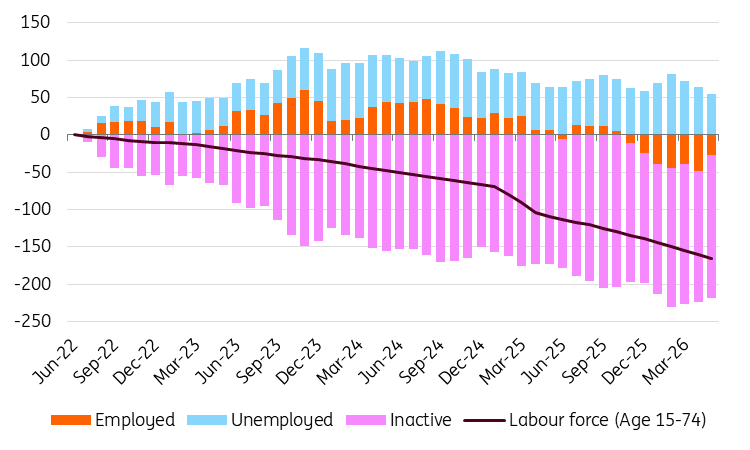
Examining the details, the monthly data reveal that although the working-age population decreased by around 5,000 people month-on-month, the number of economically inactive individuals fell by a more substantial 33,000. This means that demographic decline contributed moderately to the decrease in inactivity, while 28,000 people returned to active status.
Furthermore, the number of employed people grew faster than the number of labour market participants. In other words, around 7,000 unemployed people found new jobs. Thus, overall, the labour market saw an increase of around 35,000 people in May on a monthly basis.
Changes in the labour market since mid-2022 ('000, 3-m moving avg)
This change means that the decline in employment in April has largely been offset, and the indicator has risen to its highest level in seven months. The decline in labour demand seen last month was therefore temporary, which is interesting given that, unlike the consumer confidence index, the business confidence index has not improved dramatically. The June business confidence index was also in line with the April–May average. The latest data show that, because of demographics, the working-age population has already fallen by 165,000 by May compared to the level seen in June 2022, when the labour market peaked in Hungary.
In general, the Hungarian labour market has remained tight. The number of job openings has not declined further, and employment statistics also indicate an overall improvement based on the average over the past three months. The main question is whether this momentum can be sustained. While the economic upturn in the first quarter was partly due to one-off factors, second-quarter data – though still limited – already seem to signal a loss of momentum. The positive labour market developments we have seen so far may therefore prove to be only temporary. However, the easing of geopolitical risks and greater clarity regarding domestic economic policy changes could help to boost business confidence and prevent a negative turnaround in the labour market.
Historical trends in the Hungarian labour market (%)
Looking ahead, we do not expect any significant changes to the supply side of the labour market. With no demographic shift on the horizon, a significant proportion of companies are likely to continue maintaining a labour reserve, keeping the labour market artificially tight.
As the end of the year approaches, the issue of next year's wages is also becoming increasingly pressing. The three-year minimum wage agreement, stepping into its last year in 2027, will certainly need revising, and the expected overhaul of the personal income tax system may also create a new situation.
The sooner companies gain clarity on these factors, the sooner new trends in the labour market will begin to emerge. In light of the latest data, we are maintaining our labour market forecast for this year, which projects an average unemployment rate of around 4.5%.
Content Disclaimer
This publication has been prepared by ING solely for information purposes irrespective of a particular user's means, financial situation or investment objectives. The information does not constitute investment recommendation, and nor is it investment, legal or tax advice or an offer or solicitation to purchase or sell any financial instrument.Read more