- Opinion by Padhraic Garvey, CFA
Here’s why Colombia does not need to hike rates
- 30 June
- Rates
The market is betting that the Colombian central bank has another few hikes to deliver. Maybe. But we show here that there’s already enough of an interest-rate buffer built in from prior hikes. Add in implied tightening coming from peso strength, and there’s room to adopt a hawkish holding pattern rather than hike rates

Here are some of the pushes and pulls BanRep is dealing with
Before Banco de la República (BanRep) embarked on its latest rate-hiking spree, we sent out this note. It highlights key inputs such as the 24% minimum-wage announcement, a series of 2025 downgrades, a lurch into the BB credit-rating zone, and a heavy re-funding requirement (the 5.5% area for the fiscal deficit).
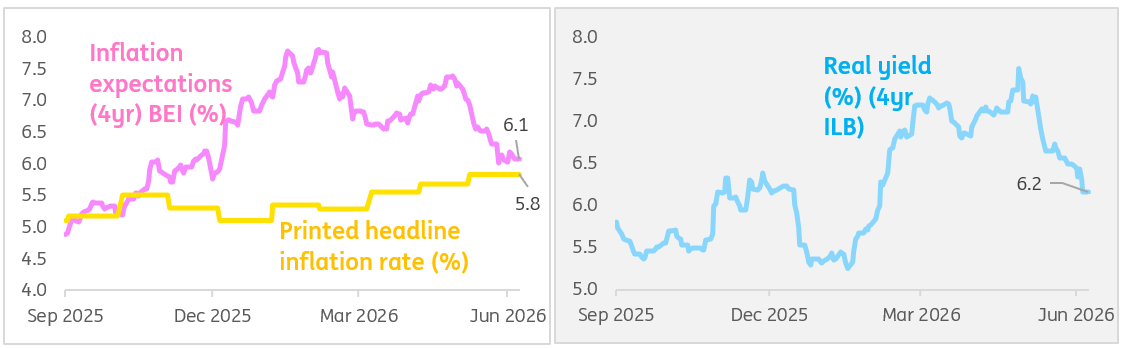
Fast-forward through 2026, the congressional elections have come and gone, resulting in policy stasis. This is not great. S&P analysts have circled back with an additional rating downgrade to BB-, the lowest among the top agencies, citing ongoing, unresolved fiscal pressures. Meanwhile, printed inflation has risen to 5.8%, well above the upper tolerance band range around 4%. Not great, hence the ongoing pressure for hikes.
Pitched against that, the 3yr breakeven inflation rate, which approached 8% in February, is back down to 6.1%. It's still too high, of course, but at least showing a tendency to head in an auspicious direction. That's the inflation piece. The fiscal deficit piece is better captured by the real yield, which has been falling. On the 3yr maturity, it's down to 6.2%. While that's still high, it peaked at 7.6% in May. We're not in a good place, but there’s been some containment of the problem.
Inflation expectations and Real Yields have been on the decline
Printed inflation is converging on inflation expectations. Still too high, but overall better
Does BanRep need to hike further or can it hold pat?
Add the real rate and breakeven inflation, and we get the 3yr yield at 12.2%. That's still high, but well down from the 15% hit a month ago. Meanwhile, foreign ownership of Colombian bonds is up some 5%, from a 2025 trough of 18%. Not that one has necessarily driven the other, but it has correlated with an impressive rally in the Colombian peso (COP).
Against this backdrop, the BanRep rate is pitched at 11.25%. It got there from two 100bp hikes, and we had a hold last time. In our opinion, that hold made full sense.
The market is anticipating a 50bp hike ahead, but we argue that a hold (and holds) ahead are entirely defensible. Why? Mostly as enough of an interest rate buffer has been built already.
There are two components to this. The first is the pure interest rate buffer. It's calculated as shown below and essentially asks how much buffer BanRep has built relative to deviations from historical norms. The final calculation is composed of an equally weighted average of three variables (see below). The outcome is 3.8%. This is the buffer that's been built. The question is, do we really need more?
The interest rate buffer calculations
Weighted average of (below) = interest rate buffer of 3.8%
- Policy rate differential versus the Fed (+3.2%)
- Domestic real policy rate (+4.4%) and
- Real policy rate differential versus the US (+3.9%)
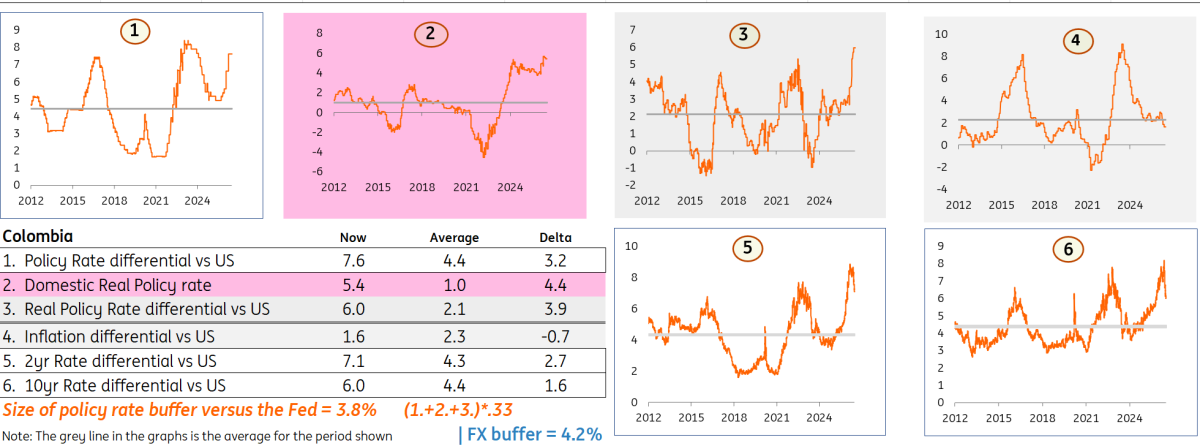
Enough of a rate buffer built in, especially given FX angle
Now let's add the FX angle: the strong Colombian peso. There is a strong positive carry story to tell here for international players, driven by the prior rise in market rates. That is part of the rationale for the peso's strength against the US dollar (USD/COP) in recent months. With imports equating to about a fifth of GDP, it’s not inconsequential as an additional element of comfort (from an imported inflation perspective). At the same time, a significant official-sector debt-swap programme has, from time to time, resulted in peso-buying pressure.
Importantly, USD/COP is currently trading at a significant deviation from levels implied by a straightforward purchasing power parity (PPP) calculation. In fact, on our numbers, the USD/COP FX rate is at such an extreme that it equates to some 4% (400bp) in interest rate hikes. That is calculated as the deviation versus a simple PPP calculation over the past 15 years, where each 1.5% deviation equates to a 25bp rate move.
BanRep could still hike, but we call for a hold
We calculate that a pure interest-rate buffer of about 3.8% has already been built by BanRep. That incorporates a domestic real policy rate of 5.4%, which is already very tight. On top of that, we find that the COP has built significant strength relative to a purchasing power parity calculation against the USD, which represents an additional 4% of monetary policy tightness. Prior peso strength could of course prove a vulnerability, should it turn tail and decide to weaken. But for now, it's giving BanRep an opportunity to hold pat, should the central bank choose to do so.
Content Disclaimer
This publication has been prepared by ING solely for information purposes irrespective of a particular user's means, financial situation or investment objectives. The information does not constitute investment recommendation, and nor is it investment, legal or tax advice or an offer or solicitation to purchase or sell any financial instrument.Read more