US solar set to see a significant supply chain reconfiguration
- 29 April
- Energy Sustainability United States
The reshoring of US solar manufacturing is moving forward, but only gradually. Continued reliance on China, combined with tariffs and FEOC rules, means developers face significant work to map, verify, and potentially reconfigure their sourcing strategies

Steep tariffs and strict foreign entities of concern (FEOC) rules under the Trump administration are accelerating a reset of the solar supply chain – on a compressed timeline. This poses challenges for developers that have long relied on China’s dominance in global production of cheap solar and battery equipment. Components with minimal Chinese exposure are likely to be in high demand, pushing up prices.
As developers rework their supply chains, short-term fixes may not be enough. More durable solutions will require building and maintaining trade relationships that can withstand future policy shifts.
Over time, a vertically integrated domestic supply chain is achievable, though it will require incentives and trade protections. The significant volume of solar cell capacity currently under construction in the US suggests progress in the right direction.
Seemingly high US module capacity does not ensure self-sufficiency
US solar manufacturing capacity has expanded rapidly. The Solar Energy Industries Association (SEIA) estimates that as of early 2026, US solar module manufacturing capacity increased 50% annually to 65GW, much higher than the domestic demand of roughly 40 GW in 2025.
While we think this is a credible and impressive data point, we caution against the interpretation that the US is self-sufficient on solar modules. In fact, the US still imported 32GW of modules last year, despite having 65GW of module capacity targeting mostly domestic customers.
US solar manufacturing capacity, imports and demand
GW
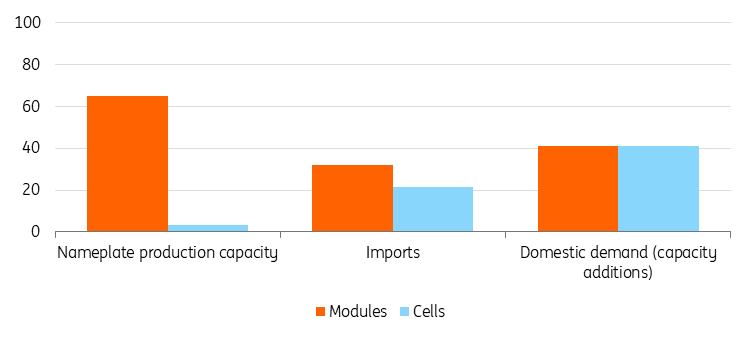
One main reason behind this is upstream manufacturing bottlenecks. Further up the supply chain of crystalline‑silicon (c‑Si) modules, cell capacity is just 3.2 GW, while wafer and ingot capacity are each around 5 GW. Therefore, US module capacity is not true ‘manufacturing capacity’, but largely ‘assembly capacity’ using imported cells.
US solar manufacturing capacity across the supply chain
GW
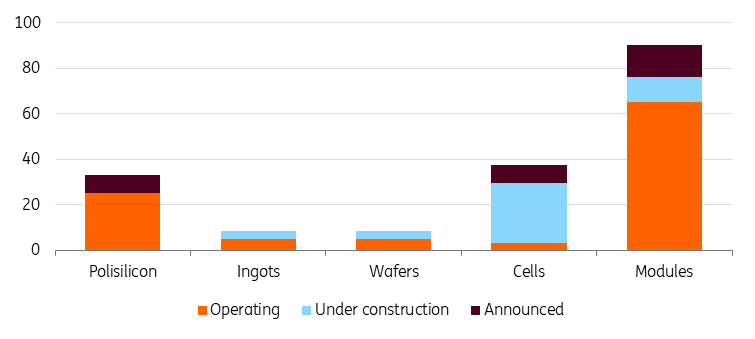
This creates additional risks. First, module manufacturers may need to produce way below nameplate capacity if they cannot secure inputs on time and at competitive prices. Second, reliance on imported cells exposes module manufacturers, and by extension solar developers, to tariffs and FEOC restrictions. By contrast, cadmium telluride modules, led by First Solar, benefit from about 14GW of fully integrated domestic capacity.
Another reason the US remains reliant on imports is price competitiveness. Even after accounting for tariffs, imported solar modules, a large share of which has ties to China, remain cheaper than US-made modules. It is also worth noting that even imported solar modules are over twice as expensive as the global average, where tariffs are minimal, suggesting the US manufacturing industry is far from competitive in the global market.
Solar module prices by technology and supply chain
cents/watt

These factors show that the US is far from fully localising its solar supply chain, though the 26GW of cell capacity under construction could improve the situation.
In the near term, however, many US projects will still rely on imports and be exposed to two policy risks: tariffs and FEOC requirements.
Tariffs continue to push China to find new trade reroutes
To curb tariff circumvention by China, the US sharply increased countervailing and anti‑dumping duties on solar imports from Cambodia, Thailand, Malaysia, and Vietnam in early 2025. This prompted China to react. At the time, we noted in a research article that alternative trade paths were emerging in Laos and Indonesia. Now, not only has 2025 trade data confirmed this move, but it has shown how fast rerouting happened.
From 2024 to 2025, the combined import share of modules from Laos and Indonesia jumped from 3% to 40%, with the cell import share from these two countries surging from 5% to 53%. In contrast, the combined import share from Cambodia, Malaysia, Thailand and Vietnam collapsed.
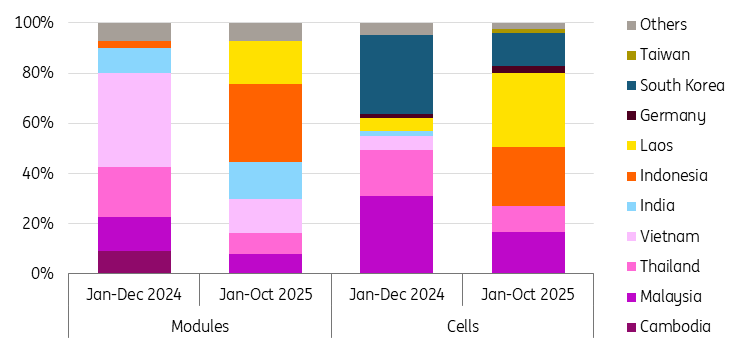
This rapid shift triggered a new US investigation. In February 2026, the Department of Commerce announced preliminary countervailing duties of 80.67%-143.3% on solar imports from Indonesia and Laos. It also imposed a 125% tariff on Indian imports, citing evidence of Chinese transshipment.
China’s manufacturing overcapacity will incentivise it to continue finding new trade routes. But doing so could become harder, as China’s remaining options in Southeast Asia are limited to markets such as the Philippines. And there is potentially Africa. Recent reports suggest solar manufacturing in Africa is expanding, although it is unclear how much is influenced by China.
Looking ahead, there are more trade issues we are watching:
- Court ruling on previous Southeast Asia tariff exemption: In August 2025, the US Court of International Trade struck down a Biden-era rule that exempted for two years hefty tariffs on solar imports from Cambodia, Malaysia, Thailand, and Vietnam. The decision is now under appeal. If upheld, it could result in over $50bn in retroactive duties, dealing a major blow to US solar.
- First Solar’s patent lawsuit: In March, the US International Trade Commission launched an investigation into whether several solar manufacturers – including Canadian Solar and Jinko Solar – are infringing First Solar’s TOPCon (Tunnel Oxide Passivated Contact) patent. The case could take up to 18 months, but a ruling in First Solar’s favour could significantly constrain solar equipment supply.
- Appetite to shift toward non-China-linked suppliers: There has been little increase in US imports from non-China-linked alternatives, such as South Korea, despite tariffs on Southeast Asian countries. It is worth seeing if that limited appetite can rise this year.
As developers map and rework their supply chains, they should focus not only on short-term fixes but also on durable solutions. For manufacturers, this means building partnerships up and down the supply chain to offer developers a more integrated model. That is the approach taken by Corning, Suniva, and Heliene, which together are establishing US‑made polysilicon, wafers, cells, and modules.
FEOC guidance prompts supply chain reevaluation – it’s all about proving yourself
Another major policy risk stems from FEOC rules, which are designed to limit Chinese influence. FEOC compliance has two parts: developers cannot be prohibited foreign entities (PFEs), and they cannot rely on material assistance from such entities. Starting in 2026, companies with PFE ties will no longer qualify for clean‑energy tax credits.
FEOC compliance criteria
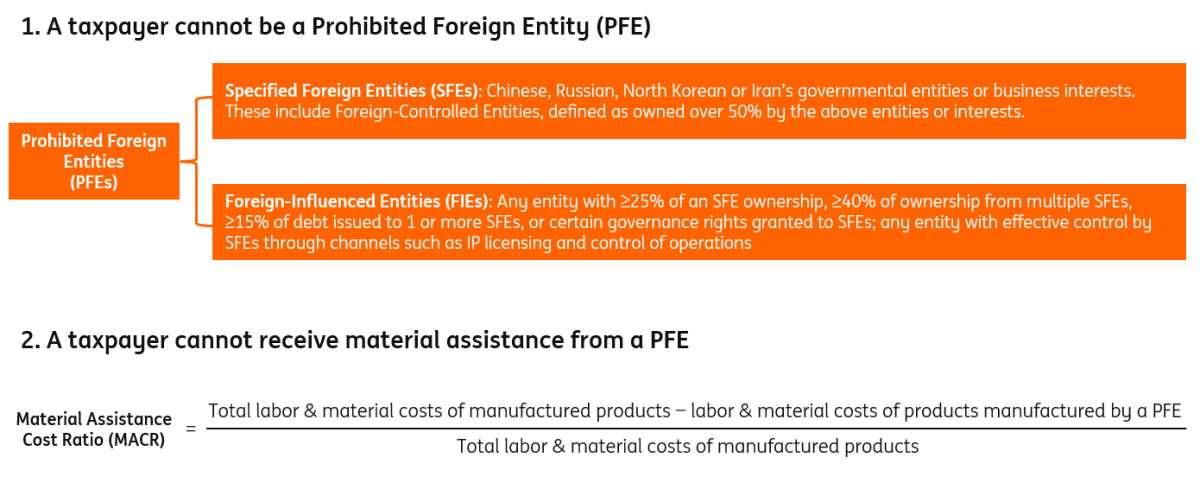
In February, the Treasury Department issued draft guidance on material assistance. The key point is that solar and BESS developers only need to review a specific list of upstream components and ensure they are free of FEOC influence. The guidance adds tremendous certainty for developers to manage supply chains and advance projects.
Treasury’s material assistance cost ratios to determine FEOC compliance

However, in practice, ensuring FEOC compliance is not easy. Making sure PV module manufacturers are not PFEs could already be challenging. BloombergNEF estimates that over 20% of US solar module capacity may have high FEOC exposure through corporate structures or IP partnerships. That could be enough to fail the FEOC test.
Manufacturers that pass ownership and IP tests can still be disqualified if they receive material assistance from PFEs. Here, ensuring cells are compliant is the most critical step, as they account for the largest share of equipment costs used to assess FEOC status. But with limited compliant supply, this step can be challenging for some developers.
And full clarity will not come until the Treasury releases further guidance later this year to define PFEs more precisely and tighten rules against circumvention. A tougher stance means that Chinese firms might not be able to comply simply through restructuring ownership, financing, or contracts.
Now, what developers need to do is not just verify whether they are FEOC compliant, but show robust proof of how they are compliant. To that end, supplier certifications do provide a certain level of comfort, as they are legally binding documents with penalties of perjury. But lenders are increasingly expecting more intense audits or third-party diligence. Detailed documentation is becoming critical to securing project financing.
Conclusion
Solar reshoring across the value chain is still progressing slowly, though momentum is building. Continued reliance on a China‑dominated global market, combined with tariffs and FEOC rules, means solar developers need significant work to make their supply chains bulletproof.
Content Disclaimer
This publication has been prepared by ING solely for information purposes irrespective of a particular user's means, financial situation or investment objectives. The information does not constitute investment recommendation, and nor is it investment, legal or tax advice or an offer or solicitation to purchase or sell any financial instrument.Read more

Included in the following bundle
How US trade and industrial policy is rewiring clean energy supply chains
- This bundle contains 2 Articles