- Quick take
- 24 March
- Rates United States
Japan’s soft inflation is temporary and won’t alter BoJ’s rate hike cycle
Japan’s consumer prices fell more than expected. Still, the Bank of Japan is likely to look through the recent inflation slowdown and focus on upside price risks. Healthy wage negotiation results and firmer-than-expected PMIs raise the possibility of an April rate hike. Still, the timing could shift, depending on the situation in the Middle East


| 1.3% |
Consumer price inflationCore-core inflation rose 2.5% YoY |
| Lower than expected | |
Government utility subsidies lower the inflation in February
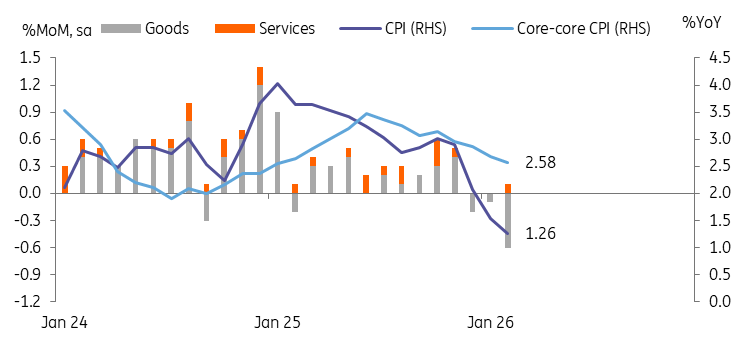
Japan’s consumer price inflation eased faster than expected to 1.3% year-on-year in February (vs 1.5% in January and market consensus). Lower prices for fresh food (-4.5%) and utilities (-5.5%) were the main reasons for the slowdown. On a month-over-month basis, inflation decreased by 0.2% (seasonally adjusted) in February. Goods prices declined by 0.6%, while services prices rose by 0.1%.
Although inflation has come in lower than expected, the Bank of Japan is unlikely to place much weight on the recent slowdown, as it was driven by utility subsidies. The BoJ will pay more attention to the underlying inflation trend. Stripping out food and energy price changes, core-core inflation edged down to 2.5% (vs 2.6% in February, market consensus) but stayed well above the BoJ’s target of 2.0%.
Despite soaring petrol prices, headline inflation is expected to remain below 2% for the next couple of months. The government’s price cap on fuel prices should absorb some of the price shocks. And base effects are likely to anchor the inflation below 2%. However, core-core inflation is expected to remain sticky, staying near 2.5%. We expect demand-side inflationary pressures to remain intact, with encouraging initial wage-negotiation results.
Core-core inflation stayed above 2%, likely support the BoJ's rate hikes
Initial wage negotiation results are encouraging
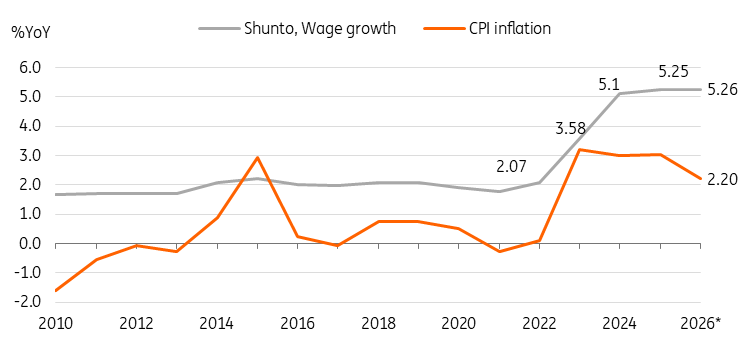
Rengo, the largest labour union group, announced that this year's average wage increase is 5.26%, just below last year's initial figure of 5.46%. This figure will be revised several times (on 27 March and 3 April, for example). But the current situation in the Middle East has had little impact on the wage negotiations so far. BoJ Governor Ueda previously noted that policymakers are monitoring whether wage gains will extend to small and mid-sized companies. Many SMEs settle their wages in April, so it is a key dynamic to monitor. The outcome should be known before the BoJ’s April meeting.
Preliminary Shunto results are encouraging
Flash PMIs dropped but still stayed above 50
The manufacturing purchasing managers’ index (PMI) fell to 51.4 from 53 in February, with both output and new orders down. The services PMI also fell to 52.8 from 53.8 in February. We believe the declines reflect recent global oil supply shocks and the drop in new orders, and that they add to concerns about the outlook. Yet the overall figures remained above 50, suggesting that businesses believe the recent geopolitical risks are temporary and maintain a positive outlook.
The BoJ will look through volatile inflation changes
The BoJ will continue raising interest rates. The exact timing—likely between April and June—is still uncertain, but now we believe an April hike has a slightly higher chance than a June hike. Sticky core inflation, stronger-than-expected PMI figures, and positive early Spring wage negotiations raise the odds of an April hike. We believe that developments in the Middle East will play a crucial role in the decision. If conditions stabilise soon and there is no evidence of declining production or consumption, the chance of an April hike will rise even more.
Content Disclaimer
This publication has been prepared by ING solely for information purposes irrespective of a particular user's means, financial situation or investment objectives. The information does not constitute investment recommendation, and nor is it investment, legal or tax advice or an offer or solicitation to purchase or sell any financial instrument.Read more