- Quick take
- 3 February
- Rates South Korea
South Korea’s moderating inflation won’t prompt central bank to cut rates
South Korea’s consumer price inflation dropped mostly because of lower food and energy prices, while core inflation stayed at 2%. Policymakers are closely monitoring property-price trends. The government has warned the market not to test its resolve to stabilise the market

| 2.0% YoY |
Consumer price inflationCore excluding food and energy rose 2.0% |
| As expected | |
Despite weak KRW, headline inflation eased in January
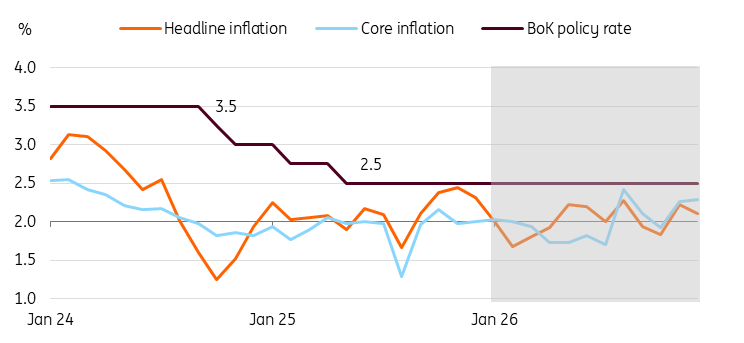
South Korea’s consumer price inflation cooled quite sharply to 2.0% year on year in January from 2.3% in December, in line with market consensus. The main drivers were lower food and energy prices (1.9% vs. the previous 3.4%), thanks to a better fresh food harvest and fuel tax-related base effects. Meanwhile, service prices stayed at 2.3% for the third month.
Looking ahead, headline inflation is expected to temporarily decline below 2%. The slowdown, however, is not anticipated to prompt the Bank of Korea to resume rate cuts. FX volatility and financial instability related to Seoul housing prices should be the BoK's main focus. Growth conditions are expected to improve in the current quarter, driven by robust AI demand and strong price action in memory chips. We believe that the BoK’s easing cycle has ended and the policy rate will stay at 2.5% for an extended period.
The Bank of Korea will keep its policy rate at 2.50% despite ongoing moderation in inflation
Korean government delivering strong market signals on real estate policy
President Lee Jae-Myung and the government delivered strong market signals by confirming the end of temporary exemption from the heavy capital gains tax for multi-homeowners. They will expire on 9 May, as scheduled. The capital gains tax on real estate sales ranges from 6% to 45%. Owners of two homes in speculative zones pay an extra 20 percentage points, while those with three homes face a 30 percentage points surcharge on the base rate.
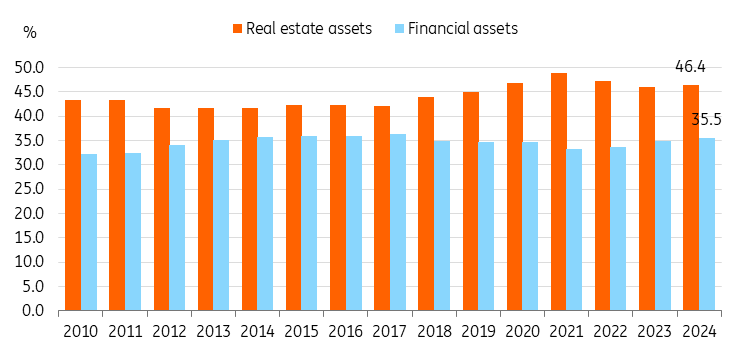
Stricter tax policies on housing may reduce prices, but they could also hurt consumer confidence since a significant portion of household assets is tied up in real estate. We believe further measures will be introduced if housing prices do not stabilise. This may negatively affect consumer sentiment in the near term. But the government seems determined to stabilise the housing market before the June local government election. We don’t expect property holding taxes to be revised at this point; they should be subject to housing market trends in coming months.
Despite the 15 October measures, the latest consumer surveys indicate rising price expectations, with Seoul's market remaining firm. As a result, the government is ramping up warnings on the housing market. The end of the tax exemption could briefly lower prices. But more effective government supply strategies are needed to ensure stability and sustainability of the housing market.
Real estate makes up a large portion of assets for Korean households, also which are concentrated in Seoul and Gyung-gi area
Content Disclaimer
This publication has been prepared by ING solely for information purposes irrespective of a particular user's means, financial situation or investment objectives. The information does not constitute investment recommendation, and nor is it investment, legal or tax advice or an offer or solicitation to purchase or sell any financial instrument.Read more