- Quick take
- 13 May
- Turkey
Middle East war drives record capital outflows from Turkey
The current account deficit continued to widen in March, as expected, while the capital account saw record outflows, leading to large reserve depletion


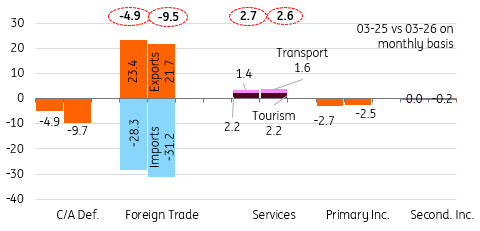
In March, Turkey's current account posted another large deficit at US$9.7bn, in line with the market consensus and our call. Following the data, the 12-month rolling current account deficit maintained the uptrend and reached US$39.7bn, or approximately 2.6% of GDP, from US$35.0bn a month ago.
A closer look at the monthly figures shows that the deficit widened by roughly US$4.8bn compared to the same month of 2025, primarily due to a higher trade gap which deteriorated from US$-4.9bn to US$-9.5bn, stemming from the turn of the core trade surplus in 2025 to a deficit and rising gold imports.
Despite the US‑Iran war pushing energy prices higher, the energy trade balance slightly improved compared with last year.
In the first quarter, however, the trade deficit widened due to the same factors seen in March, alongside a small drop in services income and bigger gaps in primary and secondary income. Together, these led to a deterioration in the current account of close to $10bn.
Breakdown of the current account
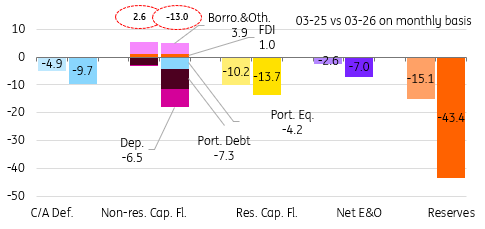
On the capital account side, the war in the Middle East weighed markedly with US$26.8bn of outflows (the largest ever). With additional outflows from net errors and omissions of US$7.0bn, and considering the current account deficit, official reserves dropped by a record US$43.4bn.
Further analysis reveals that resident activity led to outflows totalling US$13.7bn, primarily from the acquisition of portfolio assets and growing foreign deposits of local banks abroad. Non-residents also reduced their Turkey exposure by lowering their portfolio investments by US$11.4bn and deposits held at local banks by US$6.9bn. Growing trade credits by US$1.7bn and additional net borrowing of US$2.6bn partially offset the outflows.
In the breakdown of net borrowing, both banks and corporates secured long-term financing, exceeding their short-term debt repayments. This translates into long-term debt rollover ratios at 237% for corporations and 138% for banks on a monthly basis, compared to 214% and 151%, respectively, on a 12-month rolling basis.
Breakdown of financing
In the first quarter, resident outflows rose to US$12.2bn from US$9.5bn a year ago. Foreign inflows, on the other hand, recorded a drop, coming in at US$10.1bn, compared to US$14.3bn in 2025. As a result, the capital account has moved into negative territory with US$2.2bn, compared to US$+4.8bn.
In addition, outflows via net errors and omissions remained elevated, totalling US$-16.2 bn vs US$-2.3 bn in 2025. Taken together with the widening current account deficit, which grew from US$-14.1bn to US$-23.7bn, official reserves were depleted by US$42.1bn vs a US$11.6bn fall recorded previously.
Overall, the current account surplus in March continued to widen with another large deficit, while weakening capital flows led to financing of the deficit mainly via reserves. Preliminary customs data from the Ministry of Trade suggest an improvement in the April current account despite war conditions nearby, as the foreign trade deficit appears to have narrowed by close to 30% in comparison to last year, with exports strengthening.
In the months ahead, the trajectory of the current account balance is expected to be influenced by a mix of external risks alongside domestic demand conditions. In this regard, the recent geopolitical shock increases the upside pressures on the current account deficit, given the elevated trajectory of oil and gas prices, in addition to a potential decline in tourism revenues and a rise in gold imports. Regarding the capital account, a higher risk premium, if geopolitical uncertainty were to extend, would threaten more portfolio outflows.
Content Disclaimer
This publication has been prepared by ING solely for information purposes irrespective of a particular user's means, financial situation or investment objectives. The information does not constitute investment recommendation, and nor is it investment, legal or tax advice or an offer or solicitation to purchase or sell any financial instrument.Read more