- Opinion by Marieke Blom
Marieke Blom: Europe must champion its strengths and develop a clear pitch book
- 12 February
Davos crystallised the urgency around European competitiveness. Policymakers are 'on it' as we speak. But a key element is missing: confidence. Europe must articulate its strengths, and Europeans must hear its pitch – that Draghi's report overstated US success and that global investors are turning to Europe, writes Marieke Blom

Earlier this week, I asked a corporate audience a simple question: “Why was the Draghi report received so negatively?” Someone responded immediately: “Because these are the facts: nothing happens in Europe.” It’s a sentiment I’ve heard almost everywhere across the continent since the release of Mario Draghi’s report. Corporates are quick to point out Europe’s shortcomings – slow growth, excessive regulation, fragmented markets.
Political leaders are, many would say finally, taking those complaints seriously. They are now gathering in a Belgian castle to discuss how to break through old barriers and get things moving. But to truly unlock progress, we must ask: is repeating the long list of problems, gaps, and missed opportunities sufficient to create momentum?
Focusing only on problems doesn’t work
Emphasising Europe’s weaknesses alone is not enough. We all know from personal experience that growth often comes from building on strengths, not dwelling on flaws. People and economies alike respond far better to confidence than to criticism.
There’s also an economic dimension to consider. The persistent drumbeat of negativity about Europe has shaped public sentiment more deeply than many realise. In October 2025, 46% of Europeans said the economic situation was bad, even though the economy was performing reasonably well. Negative sentiment affects behaviour. It may be contributing to hesitant corporate investment, high savings ratios, and the fact that eurozone residents hold a large chunk of their financial wealth in deposits, while directing as much as half of their equity investments – 1.7 trillion euros – outside of Europe.
In other words: there is a confidence problem. And confidence matters for growth.
Europe rarely highlights its strengths
Europe does not have a habit of pitching itself. In the conversations and speeches I listened to in Davos, there were occasional references to Europe’s strong points. But typically, the narrative quickly shifted back to what must be fixed.
That sparked an idea: perhaps Europe needs its own Pitch Book.
If we were to “sell” Europe to Europeans – what messages would belong on the first slide?
A good pitch always starts with knowing the audience. For Europe, the audience is its own citizens: voters, investors, workers, entrepreneurs. These people will ultimately power Europe’s transformation. And to do that, they need to believe the continent can succeed. So the pitch book should begin with strengths Europeans recognise and can be proud of – credible, relevant, emotionally resonant strengths.
Three strengths every European knows
- Europe is reliable. Europe’s democracies move slowly. Some see this as a flaw. But like the fable of the tortoise and the hare, slow and steady can win the race, especially when it avoids zigzags and abrupt shifts. Stability is not exciting, but it creates confidence. And Europeans know it: 67% agree that the EU is a place of stability in a troubled world.
- Europe protects fundamental values. From freedom of speech to social equality and welfare, Europeans overwhelmingly agree: there is no better place in the world than Europe when it comes to these core values. This matters. Values underpin trust, cohesion, and societal resilience – key ingredients for long‑term prosperity.
- Europe is an economic giant. If you combine the EU, the UK, Switzerland, and Norway, Europe’s economy is similar in size to that of the US. Many Europeans identify economic, industrial, and trading power as one of the continent’s most important strengths. They are well aware that size matters. It gives leverage, flexibility, and global influence.
And three strengths Europeans often overlook
A compelling pitch book also includes the surprising facts – the strengths that people do not immediately see.
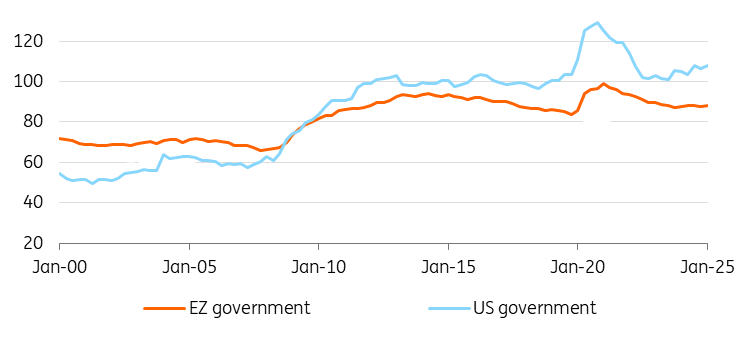
- Europe did not pile up debt the way the US did. The Draghi report highlights the US economy outperforming Europe since 2000. But it did so without addressing the elephant in the room: that US growth was fuelled by government debt. US debt‑to‑GDP increased by 53 percentage points, compared with only 16 points for the eurozone. The report largely ignored this. It should come as no surprise that an economy running on less debt creation is going slower. Comparing the two without adjusting for the debt factor distorts reality.
Eurozone debt to GDP levels have remained relatively stable over time
Debt to GDP ratio (%)
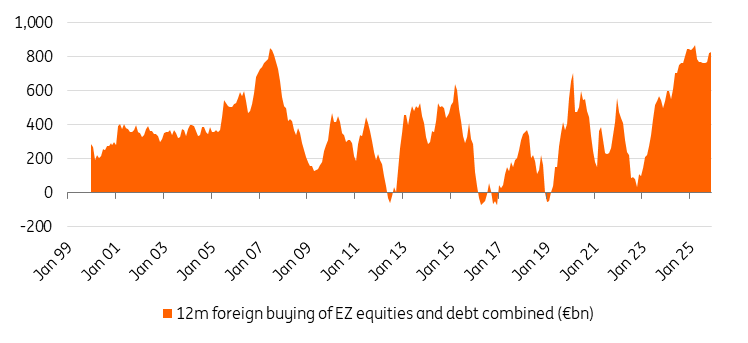
- Europe is increasingly attracting global investors. Foreign purchases of eurozone debt and equity are currently at their highest pace in nearly two decades. Global investors are voting with their wallets, and they are choosing Europe. Recent investment returns in Europe have also outperformed many other regions.
Foreign investors’ purchases of eurozone debt and equities is peaking
- Europe is acting – quietly but steadily. As of January this year, 15% of Draghi’s recommendations had already been fully implemented. It’s not flashy. It’s not fast. And sure, you can even debate the measurement. But like the tortoise, Europe is moving. Progress is happening, even if it doesn't make headlines.
A story worth telling
Europe is far from perfect. It needs reform, investment, and bold action. But it also needs belief. A narrative rooted only in shortcomings won’t mobilise people, corporates, or policymakers.
A pitch book that combines three well‑known strengths with three surprising facts creates a compelling frame. It shows Europe as stable, values‑driven, and economically powerful yet also fiscally responsible, globally attractive, and steadily improving.
That is a story worth telling. And if Europe wants momentum, it should start telling it – to its own people – loudly and confidently.
Content Disclaimer
This publication has been prepared by ING solely for information purposes irrespective of a particular user's means, financial situation or investment objectives. The information does not constitute investment recommendation, and nor is it investment, legal or tax advice or an offer or solicitation to purchase or sell any financial instrument.Read more