- Opinion by Rico Luman
Easing electrification offers relief to European carmakers – but at a cost
- 17 December 2025
- Transport & Logistics Manufacturing, Construction and Retail
The proposed automotive package will make CO2 targets more flexible, lift the milestone EU ban on sales of ICE cars (agreed just over three years ago), and provide relief for carmakers in challenging times. It won’t change the future, though – and the risk of slowing and complicating the transition could even threaten the industry’s competitive position
Auto package lifts the ban on internal combustion engine cars and introduces flexibility as well as complexity
1. What has been proposed and why?
- The 100% ban on internal combustion engine cars (ICE) by 2035 will be lifted, while a 90% CO2-reduction from electrification remains. The last 10% needs to be achieved by using green steel or sustainable, renewable fuels.
- The intermediate target of 2030 will be extended to 2032 by using credits averaging the target (banking & borrowing). Similarly, the EU previously decided to extend the 2025 target to 2027.
- Sales of small electric cars, made in the EU, will be incentivised via so-called ‘super-credits’.
- Member states will have to introduce binding targets for decarbonising corporate fleets by 2030 at the latest.
Lagging private demand, difficult market conditions and dependence on China are reasons for adjustment
European carmakers struggle to deal with the CO2-reduction targets in the current market, risking large fines and forcing them to push electric vehicle (EV) sales. The proposed adjustment to the CO2 regulation is an early review of the industry framework. Car manufacturers point to lagging demand for EVs; at the same time, the industry is being pressured in multiple ways as export and market stakes in the US and China are threatened, car sales at home are persistently low, and margins are subject to erosion due to less profitable electric cars and competition with Chinese brands.
Sourcing risks have added to that this year, with curbed exports of rare earth minerals and chips from China. The European automotive supply chain isn’t yet up to speed enough to reduce dependence and to deliver on the ambitions to source more from Europe.
The package will keep other technologies alive for longer and reduces future clarity
2. What is the anticipated impact, and what does it mean for electrification?
The auto package will imply a further softening of the CO2 trajectory, although 90% by 2035 is still ambitious, particularly for lagging carmakers. It provides more flexibility for optimising the car sales mix along the way and opens up an opportunity to prioritise more profitable hybrids for longer.
Lowering ambition is a future risk
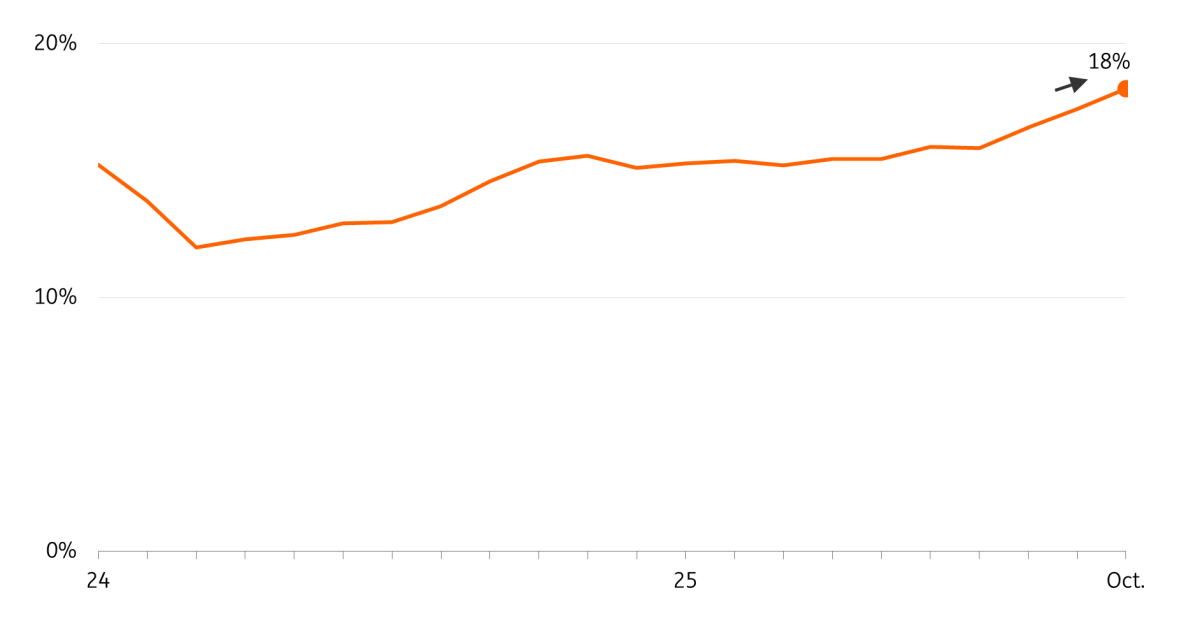
Softening the intermediate milestone for 2030 risks a slowdown of electrification, which is currently seeing decent momentum. Current policy requires a further drop from 90 gr/km in 2025-2027 to 49.5 gr/km in 2030 and 0% in 2035, which demands a rapid acceleration of around 17% in 2025 to 60% in 2030. This is now likely to end up lower.
Flattening the further uptake could also delay electrification of the fleet and CO2 emissions reduction from the car fleet, which takes us far beyond 2035.
Keeping other technologies alive and introducing new credits comes with complexity
From an industry perspective, the risk is that the package will slow down investments in EV technology as well as the general makeover of product portfolios, while keeping other technologies on the shelves (as well as associated investments). It may also reduce the urgency for lagging European member states to catch up in EV sales (and infrastructure).
For high-end and specialised cars, the new rules provide an escape route for the combustion engine, as they can pool their CO2 reduction efforts. To compensate for the final 10% of CO2 reduction from cars by 2035, carmakers could use credits for using green steel and renewable fuels. However, this creates complexity and will likely lead to extra discussions going forward.
Special support for small cars is a positive element for EV adoption
Addressing the need to sell more small cars is a positive step. Smaller electric models are less profitable and prioritised. The range of models needs to be expanded quickly to meet the needs of middle-class drivers and compete with Chinese brands. Counting small cars for 1.3 for the CO2 targets may slow progress elsewhere, but offering affordable new EVs alongside used cars will be a crucial part of the transition.
The package opens the floor for ongoing discussion, it isn't a done deal yet
3. What’s the conclusion, and what’s next?
The auto package provides flexibility for the automotive industry in difficult times, but it also introduces uncertainty, risks reducing the push for EVs and delaying the scaling up of what is inevitably the future technology. Instead, other technologies – conventional cars, hybrids and plug-in hybrids – will be kept alive for longer while EVs eventually grow cheaper. The direction of travel won’t change, nor will the urgency to compete with Chinese competitors.
The plan introduces ‘pragmatism’, but complexity too, particularly in the final stages. Member states are responsible for targets on corporate fleets, which also comes with uncertainty as the difference in adoption grows.
Generally, an adjustment of the regulation just three years after the milestone adoption risks the impression that further adjustments may be possible. Auto industry body ACEA refers to a ‘first step’, and suppliers' body CLEPA still points to unresolved issues.
All in all, this signals the discussion isn’t over. And member states will have to do their job when it comes to corporate fleets, too. The proposed package requires approval of the European Parliament and member states. We suspect the story isn't finished just yet.
Check where stand now in electrification:
Momentum for new electric cars in the European Union...
Share of battery electric cars (BEV) in European new car registrations (EU), three month rolling average
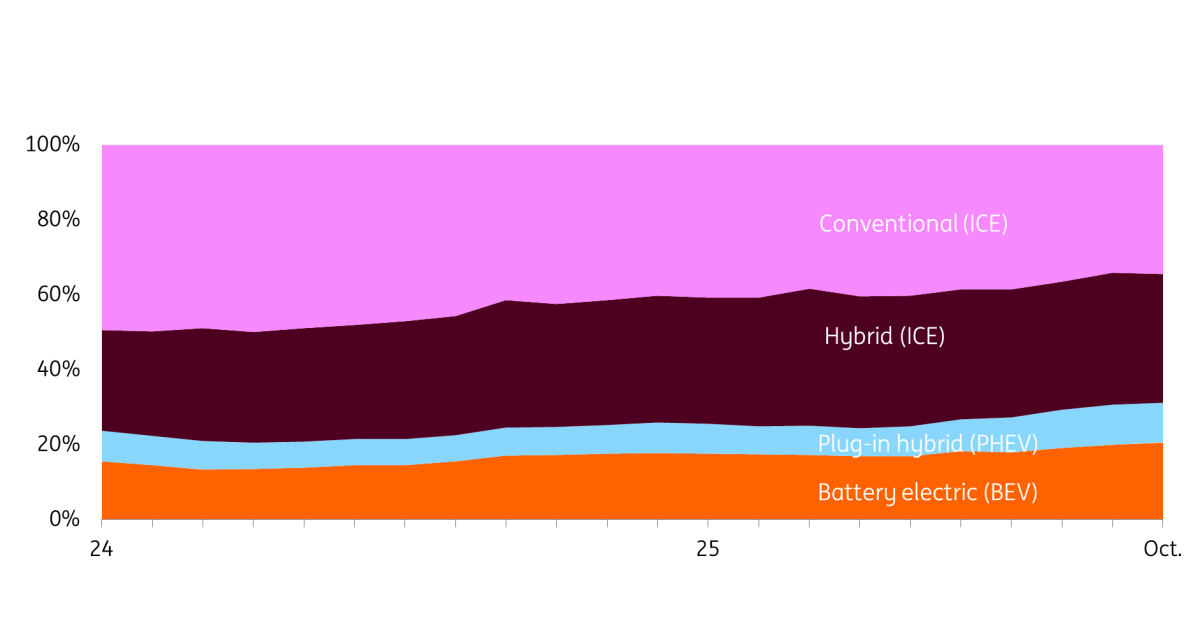
...but the car sales mix still has a long way to go to get to 90% BEV
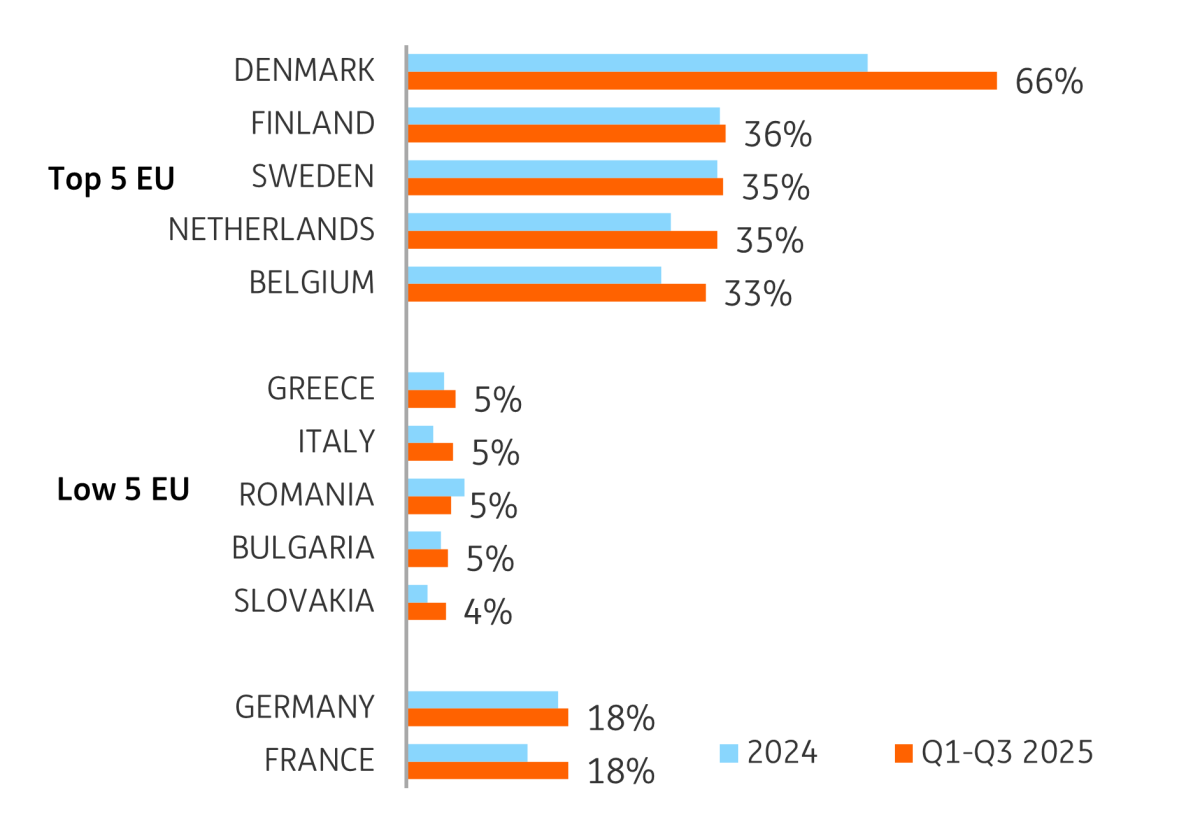
Growing differences in electrification of new cars across the EU
European Union top 5 countries with the largest shares of full electric vehicles (BEV) in new car registrations and top 5 countries with the smallest shares.
Content Disclaimer
This publication has been prepared by ING solely for information purposes irrespective of a particular user's means, financial situation or investment objectives. The information does not constitute investment recommendation, and nor is it investment, legal or tax advice or an offer or solicitation to purchase or sell any financial instrument.Read more