The pivotal Lisa Cook case: a tipping point?
- 11 September 2025
- Rates United States
The Lisa Cook affair is a pivotal test case of the Trump administration's capacity to fire Fed governors, practically at will. We could see more of this, and if pushed too far, it risks Fed credibility. We'd look to longer tenor bonds to react the most should the Fed be seen to be over-cutting for political reasons


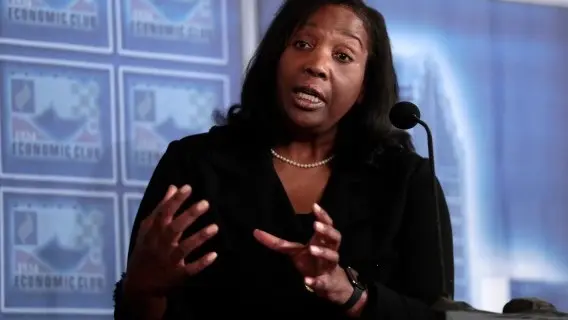
Good news for Lisa Cook as a court rules in her favour – but this is far from over
A few weeks ago, President Trump attempted to fire Federal Reserve Governor Lisa Cook for "cause". The identified "cause" was the alleged falsification of mortgage documents prior to her taking up the role of governor. There has been a court hearing on the matter, and we’ve just had the outcome, which is a positive one for Cook. Essentially, the court ruled that "cause" should reflect something done while actually in office, followed by the assertion that a firing based on "unsubstantiated and vague allegations" would "endanger the stability of our financial system". Cook keeps her job and gets to vote at the upcoming FOMC meeting.
But this is not over. The Justice Department is likely to appeal on the theory that even if Cooks' alleged falsification of documents is viewed as minor under some interpretations, it may still be sufficient grounds for removal. In the extreme, this could go all the way to the Supreme Court. And if it did, that court has tended to swing right. Either way, this whole affair does smack of a political agenda to make changes at the Fed by the Trump administration.
A burning question is why the markets have not reacted more negatively? After all, this does smack of political interference. Part of the explanation could lie in the perception that the allegations - while unproven - retain a degree of plausibility in the eyes of investors, at least until definitively dismissed. Some investors may also trust the courts to uphold due process, reinforcing faith in institutional safeguards.
However, if Chair Jerome Powell were to get involved as an obstacle, say, for attempting to protect Cook, and were fired on that basis, that would be a whole different story. Take us there, and the market would react more dramatically. In the end, any extreme action taken to undermine Fed independence would be viewed with much suspicion by longer-dated bonds.
The front end does not care about longer-term risks, as it is slavish to where the funds rate goes. By definition, it cannot think beyond two years. But the back end is a deeper thinker, and can worry about second- and third-round effects, and especially on medium-term risks potentially being taken on inflation should the interference with the Fed be seen to be swinging policy too dovish.
This has the potential to get very messy, and could finally tip the back end over the edge – an edge it has thus far resisted crossing, even under significant fiscal pressure. How messy? It's tough to say, but we'd more than likely comfortably take out the previous 10yr and 30yr yield highs seen in this cycle.
Upcoming rate cuts have little to do with the Lisa Cook case, but beyond that this theme is potentially extremely relevant
In the wake of the latest round of weak jobs data and a downbeat assessment on the economy from the Federal Reserve’s own Beige Book report, the market is now convinced the Fed will soon resume cutting interest rates. While this is mostly aside from the Lisa Cook saga, the market’s hunger for cuts has been further fuelled by the prospect that the Fed is set to lean more dovishly in the months ahead as Donald Trump seeks to appoint new members who are more aligned with his thinking that interest rates need to be much lower than they are currently.
The anticipated changes in personnel at the Fed mean there is a perception in the market that the “new” Fed could be seen to be more willing to put the political goals of the president ahead of economic stability, similar to when Richard Nixon pressured Arthur Burns into cutting interest rates ahead of the 1972 election. In combination with a lifting of wage and price controls, this contributed to a spiralling of inflation in subsequent years.
Nonetheless, it is important to point out that no potential Fed candidate has endorsed the president’s call for 200-300bp of immediate interest rate cuts.
Stephen Miran is set to be in position for the 17 September FOMC meeting, temporarily filling the governor role vacated by Adriana Kugler after she decided to step down early. Miran has somewhat controversially refused to resign from his current role as chair of the President’s Council of Economic Advisors. Instead, he is taking a temporary period of unpaid leave, raising questions about how independent he can be, given that he will be returning to work for the president in early 2026.
It will then be up to President Trump to name a permanent successor to Kugler, and with the future of Lisa Cook in doubt, plus Jerome Powell’s term as Fed Chair ending in May 2026, the composition of the FOMC will soon look very different to how it started 2025. Nonetheless, we must remember the FOMC is a committee made up of 12 voting members, and while any new members joining in the coming months may be in favour of lower interest rates right now, given the current economic conditions, there is no guarantee that will be the case if the economic situation changes.
Financial markets will also provide a stiff test for new officials. In the UK, the reason that the then newly elected Labour government gave the Bank of England independence in 1997 was to give the new political administration more economic credibility. It was believed that an independent central bank gives financial markets greater confidence that inflation would be more stable at lower levels, and this reduced term premium, which helped deliver lower market interest rates and stronger economic growth than would have been otherwise achieved. If global markets started to question the credibility of US economic policy, this could risk higher borrowing costs and slower growth, which would not be in the president’s best interests as we head towards the mid-term elections.
Content Disclaimer
This publication has been prepared by ING solely for information purposes irrespective of a particular user's means, financial situation or investment objectives. The information does not constitute investment recommendation, and nor is it investment, legal or tax advice or an offer or solicitation to purchase or sell any financial instrument.Read more
Authors


Included in the following bundle

ING Monthly: Europe’s summer of disillusionment
- This bundle contains 16 Articles