Why eurozone capital markets offer an advantage to tech firms
- 9 October 2025
- Credit TMT
Foreign tech companies have issued more euro-denominated debt than expected so far in 2025, driven by attractive funding costs in euro markets. This points to European strength. Our expectations for 2025 debt issuance were initially lower as US tech firms can fund their heavy capital expenditure programme from cash flows



EUR corporate supply forecast: €400bn in 2025
The market is well on its way to reaching our forecast of €400bn in EUR corporate supply for 2025. This forecast, which marks an increase in supply compared to FY24, is driven by higher redemptions, capex, M&A activity and technical market factors. We currently stand at year-to-date (YTD) supply of €346bn. Given relatively tight credit spreads, the supply has been well absorbed, and we maintain our FY25 forecast.
EUR IG Corporate supply per sector for 2025 (€bn)

TMT supply is ahead of our expectations
Although our supply expectations work out relatively well, the debt issuance by companies in the TMT sector is well ahead of our expectations. We expected similar issuance levels for FY25 as in FY24, because debt redemptions were similar. Also, most companies are not looking to increase leverage. Growing EBITDA and bolt-on M&A drove our expectation of €10bn net supply for FY25. However, we are now looking for a net supply of €39bn, as US-based TMT companies have raised much more debt in euro markets than expected.
What has been the contribution of Reverse Yankee issuers?
Normally, euro-denominated TMT debt issuance is driven by European telecom companies. However, this year, US-based companies account for a disproportionate share of total issuance, as can be seen in the table below. While US-based companies accounted for an average of 25% of total euro-denominated TMT issuance in the last five years, their share has risen to 36% this year. As we’ll show below, this remarkable increase is largely driven by favourable funding costs.
TMT euro-denominated debt issuance broken down by region and year (%)

Why did US companies come to the European debt markets?
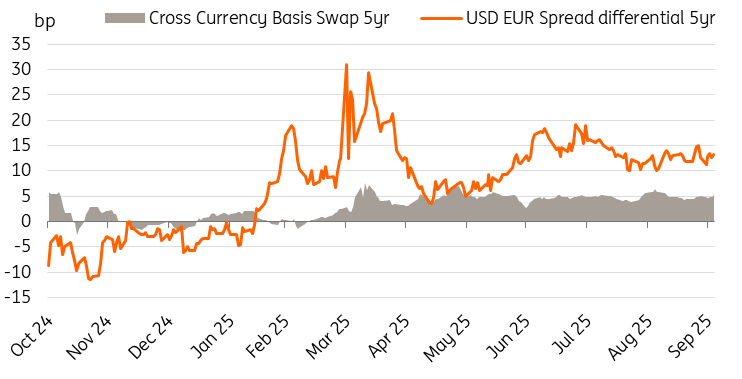
The main driver for this supply has been that the European market has been favourable for funding, as market conditions align to offer cost-saving opportunities for US issuers. This year, EUR credit has outperformed USD credit. Our initial assessment is that geopolitical events contributed to this change. The market move indicates that investors have a preference to invest in European corporate bonds. As a result, the USD-EUR credit spread differential has been widening, as shown below.
As the costs to hedge currency risk have been low, as expressed by the cross-currency basis swap, European credit markets continue to offer a cost-saving advantage for US issuers when they come to the EUR market and hedge their FX risk. This is in addition to US issuers also financing their European operations at a lower yield level.
We forecast corporate Reverse Yankee supply to reach up to €85bn in 2025. This will be much higher than the 10-year average issuance volume of €60bn, as well as last year’s €65bn figure. Note that the current YTD Reverse Yankee supply amounts to €63bn. Opportunistic funding will be a large driver for the increase in supply. Additionally, redemptions for Reverse Yankee bonds will rise in 2025 up to €47bn, an increase from the €39bn that matured in 2024.
Cross-currency basis swap & USD EUR spread differential (5yr)
Reverse Yankee supply YTD vs FY

NTT, Alphabet and IBM have raised large amounts in euro debt markets
Our forecast miss for issuance by the TMT sector has been driven by a few jumbo deals by non-traditional issuers in euro debt markets. Notably, among these issuers were quite a few operators of data centres. The Japanese telecom and data centre operator NTT has issued €5.5bn of euro notes, Alphabet (Google) has issued €6.75bn and IBM €2.75bn. These are sizeable amounts, as we initially expected the issuance of €50bn of euro notes by TMT companies in FY25. Note these companies have made sizeable acquisitions in 2025.
IBM announced the acquisition of Hashicorp, Alphabet announced the acquisition of cloud security platform Wiz, and NTT obtained full ownership of its daughter NTT Data Group. A year ago, it was well known that data centres had to fund substantial investments. Nevertheless, our expectation was, and is, that these companies could fund their investments out of operating cash flows. The reason that Alphabet came to the euro market marks a shift in their funding preference and cash management, not so much a change in leverage. In this article, we'll show big tech’s ability to fund its capital expenditures by operating cash flow.
Foreign technology firms have issued sizeable tranches, NTT being the largest issuer from Asia, while Alphabet and IBM are in the top four US issuers

Pure-play data centres have also raised debt in euro markets
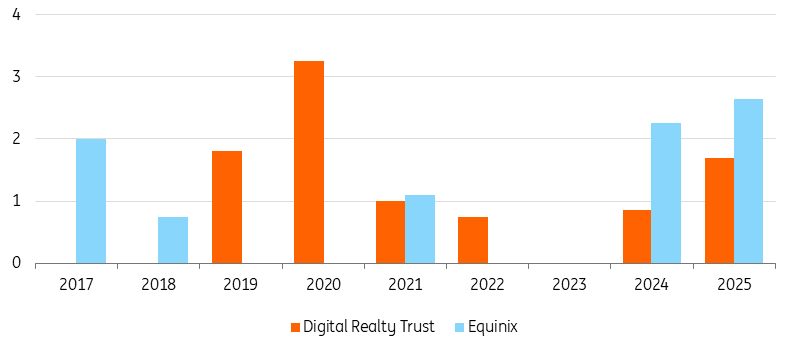
Besides the large technology platforms expanding their hyperscale footprint, there are also pure-play data centres, focusing on co-location and interconnection. Issuance by these operators is not in the statistics of the TMT sector, as they qualify as real estate investment trusts. Although issuance of the two largest pure-play data centres has been lower than the likes of Alphabet, they have also come to the euro market (figure below). So far in 2025, Equinix has raised €2.65bn in euro markets, while Digital Realty Trust has raised €1.7bn. Neither company has raised USD-denominated debt in 2025.
Pure-play data centres have issued large amounts of € debt in 2025 (bn)
S&P has upgraded the credit ratings of Equinix and Digital Realty Trust
Rating agency S&P also acknowledges the strong position of Equinix and Digital Realty Trust in the interconnection market and has recently upgraded the credit ratings of both companies to BBB+. This is in line with the credit rating of telecom operator Orange.
Content Disclaimer
This publication has been prepared by ING solely for information purposes irrespective of a particular user's means, financial situation or investment objectives. The information does not constitute investment recommendation, and nor is it investment, legal or tax advice or an offer or solicitation to purchase or sell any financial instrument.Read more