Slight recovery for the Dutch staffing industry in 2026
- 9 February
- The Netherlands
The Dutch staffing industry is facing a radical transition. Stricter legislation and a structurally tight labour market are putting pressure on the traditional revenue model. ING Research suggests only a modest recovery in 2026, while a shake-up among staffing firms appears unavoidable


Modest growth expected in 2026
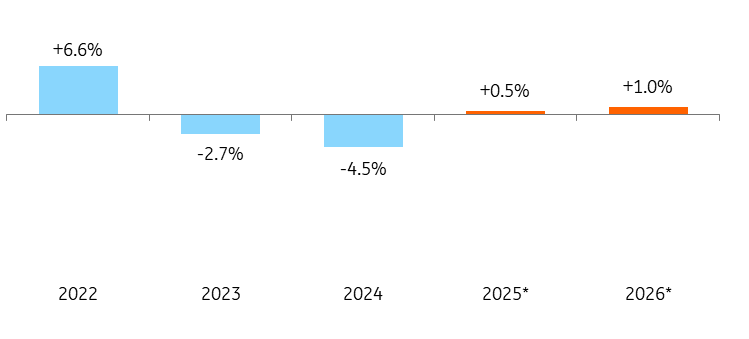
After two consecutive years of contraction, the number of hours worked in the Dutch staffing sector, which includes temporary employment agencies, secondment agencies, and payroll services, stabilised last year. For 2026, we anticipate slight growth of around 1% in temporary employment hours. With the economy showing signs of recovery, companies are expected to cautiously increase investment, driving a gradual rise in labour demand. In 2025, businesses remained hesitant, partly due to global uncertainty and political instability in the Netherlands.
Slight growth in demand for flexible workers in 2026
Volume growth in the flexible employment sector in the Netherlands, year-on-year
Stricter enforcement of false self-employment leads to labour market shifts
The renewed enforcement of rules against false self-employment at the start of 2025 also contributed to employers’ reluctance to hire flexible workers. Some activities previously carried out by self-employed professionals were no longer permitted under that status, prompting notable shifts in the labour market.
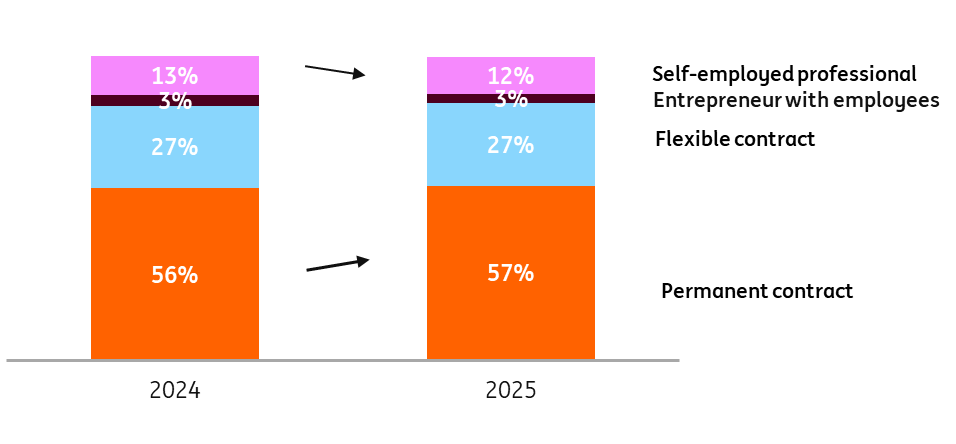
Companies increasingly opted to hire workers directly, either on permanent or flexible contracts. Statistics Netherlands data supports this trend: in the third quarter of 2025, the number of self-employed professionals in the employed labour force fell by 73,000, reducing their share from 13% to 12%. At the same time, the number of employees with permanent contracts rose by more than 100,000. This increase reflects not only a growing workforce but also a transition from flexible to permanent positions and from self-employment to salaried roles.
More permanent contracts, share of self-employed professionals declined
Labour market position of the employed labour force in the Netherlands, third quarter
Market conditions remain challenging
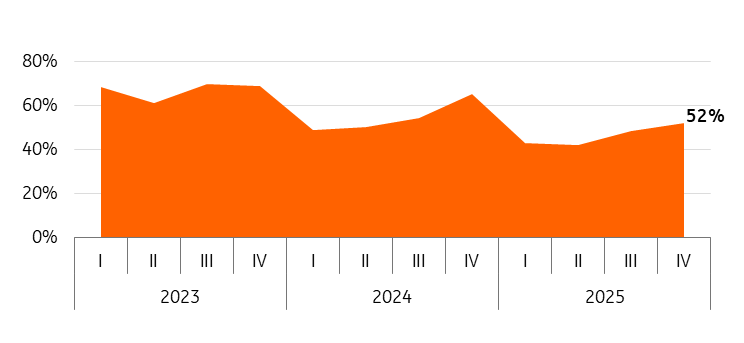
The flex industry continues to face difficult market conditions, driven largely by a structural labour shortage and increasingly stringent regulations. By the end of 2025, more than half of staffing firms were experiencing shortages of both internal staff and temporary workers. This shortage limits their ability to grow: fewer consultants and fewer available candidates mean fewer new placements. At the same time, the persistent mismatch between supply and demand means that many available candidates still do not meet employers’ requirements.
Almost half of flex companies in the Netherlands are still struggling with staff shortages
Share of staffing firms in the Netherlands affected by labour shortages
Legislation makes temporary work more expensive and less flexible
Beyond the renewed enforcement against false self-employment, several legislative proposals aim to further reform the labour market, including the 'More Security Flex Workers' Act. Under this proposal, from 1 July 2026, temporary agency workers will be entitled to the same rights as employees on payroll, such as a market-aligned pension and transition pay.
The overarching goal is to create a level playing field between different forms of employment and to offer temporary workers more security. However, this also means that temporary work becomes both more costly and less flexible for hiring companies.
Shake-up among staffing agencies expected
As temporary work becomes more expensive, competition based on minimal employment conditions is no longer viable. A significant part of today’s temporary work model will therefore struggle to remain sustainable. This is likely to trigger a shake-up, particularly among agencies that rely heavily on low-margin business models enabled by reduced employment conditions.
Strategic repositioning becomes essential
The era of competing primarily on low rates is over. Where volume once dominated, differentiation is increasingly driven by quality, expertise and specialisation. Staffing companies must reinvent their proposition. Those that fail to invest in training, advisory services and sustainable employability are unlikely to survive in the evolving market.
Content Disclaimer
This publication has been prepared by ING solely for information purposes irrespective of a particular user's means, financial situation or investment objectives. The information does not constitute investment recommendation, and nor is it investment, legal or tax advice or an offer or solicitation to purchase or sell any financial instrument.Read more