Low June inflation highlights Poland’s resilience despite past energy shock
- 15 July
- Poland
Lower fuel and food prices brought Poland’s CPI inflation back to target in June, with little evidence of spillovers from the previous energy shock. Inflation should stay below 3% this year but renewed Middle East tensions leave little room for rate cuts and call for a cautious policy stance


Fuels and food push inflation down in June
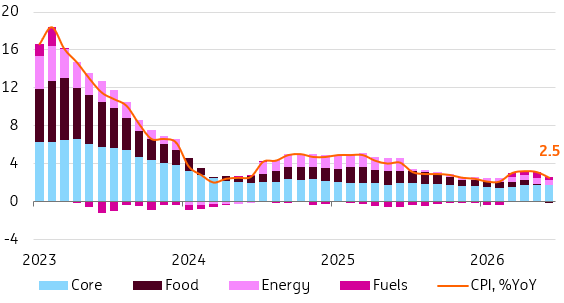
Statistics Poland (GUS) confirmed its preliminary estimate of June inflation at 2.5% YoY. The decline from 3.1% YoY in May was driven mainly by lower fuel prices (-7.4% MoM) and lower prices of food and non-alcoholic beverages (-0.7% MoM).
On an annual basis, fuel price inflation slowed from 12.3% YoY in May to 5.3% YoY in June, subtracting 0.4pp from the headline inflation rate. In the case of food and non-alcoholic beverages, annual price growth of 0.5% YoY recorded in May turned into a slight annual decline (-0.2%) in June, knocking off further 0.2pp from headline inflation. We estimate that core inflation excluding food and energy prices eased to 3.0% YoY in June, down from 3.1% YoY in May.
Lower food prices were supported, among other factors, by declining prices of fruit and nuts (-6.0% MoM) and vegetables (-2.4% MoM). Meat and dairy prices remained broadly unchanged month-on-month. While declines in seasonal food prices are typical during the summer months, this year they appeared earlier and have been more pronounced.
The decline in fuel prices was supported by the ceasefire between the United States and Iran in mid-June, which contributed to a fall in crude oil prices from around US$92/bbl at the end of May to US$73/bbl at the end of June.
Energy shock not spilling over into other price categories
The decline in core inflation suggests that the previous increase in fuel prices is not currently generating broader price pressures across other goods and services. Deflation in clothing and footwear continues both on an annual and monthly basis. Price declines were also observed in some categories closely linked to fuel costs, where increases had previously been recorded. These included transport services (-2.0% MoM), particularly air transport (-9.1% MoM).
In the "recreation and culture" category, which had previously shown some signs of impact of the energy shock and contributed positively to annual inflation, the trend has now reversed. Annual price growth in this category is moderating as the seasonal increase in package holiday prices (4.3% MoM) has been smaller than a year earlier, while deflation continues in categories covering goods related to recreation and culture.
CPI inflation to remain below 3% until end-2026
At the end of June, the government measures targeted at compressing gasoline prices (lower excise duty, lowered VAT and cap price) expired. The restoration of the VAT rate from 8% to 23% led to an increase of around PLN 0.90 per litre in petrol and diesel prices during the first days of July. As a result, July will likely bring a temporary increase in inflation.
According to our forecasts, inflation should remain within the 2.5-3.0% range through the end of the year. This does not warrant interest rate hikes, particularly given the absence of second-round effects or persistently elevated inflation expectations following the increase in fuel prices seen in March.
Rates to remain unchanged in 2H26 as renewed conflict in Iran calls for caution
National Bank of Poland (NBP) Governor Adam Glapiński adopted an even more dovish tone in July than the already soft stance presented in June. The NBP's relatively accommodative stance contrasts with the moderately hawkish rhetoric of other major central banks, including the CNB, ECB and the Federal Reserve. Glapiński seemed unconcerned by the risks linked to the renewed tensions in the Middle East, but subsequent comments by the other Monetary Policy Council (MPC) members seemed to show more caution amid elevated uncertainty.
Given the risk of an increase in inflation in the coming months and the persistently high uncertainty surrounding developments in the Middle East, we see no room for interest rate cuts this year. Our baseline scenario continues to assume that NBP interest rates will remain unchanged throughout this year. We also do not believe that there is currently a majority within the MPC to support the post-summer interest rate cut advocated by Glapiński.
Content Disclaimer
This publication has been prepared by ING solely for information purposes irrespective of a particular user's means, financial situation or investment objectives. The information does not constitute investment recommendation, and nor is it investment, legal or tax advice or an offer or solicitation to purchase or sell any financial instrument.Read more