Austria: A brighter year ahead, if you don’t look too closely
- 13 January
- Austria
After years of soaring inflation and sluggish growth, Austria is finally seeing glimmers of hope. But don’t mistake it for a full recovery. At best, this year’s improvements will conceal deeper structural challenges. Think of it as a winter sunrise in the Alps: brighter skies, but the chill remains


Inflation cools and growth returns
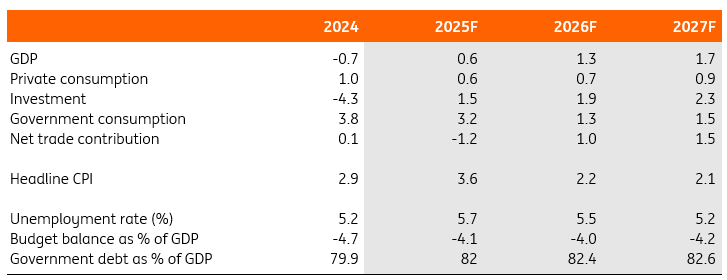
On a positive note, inflation, one of Austria’s biggest economic headaches in 2025, is set to ease. At 3.6% YoY, Austrian headline inflation ranked among the highest in the eurozone last year, driven by negative base effects in energy prices after government relief measures, like the “electricity price brake”, expired at the end of 2024. In 2026, this reversal effect will have disappeared. Due to inflation-indexation in many parts of the economy, these favourable developments will have broader positive ripple-through effects.
Growth numbers will look better as well. After three years of near-stagnation, with the economy shrinking by an average of 0.1% per quarter, Austria is poised for a modest rebound. External demand will lead the way: recovery in Germany and Eastern Europe should lift Austrian industry and exports. Domestic demand, however, remains a weak link. Households remain cautious, with high savings rates and a low appetite for spending. A softer labour market may ease inflation, but could reinforce precautionary saving too.
The economic slump is over, but don’t expect fireworks. We forecast Austrian GDP to grow by some 1% in 2026 – a step forward, but hardly a leap.
Competitiveness remains on thin ice
Furthermore, short-term gains won’t fix Austria’s competitiveness problem. Structural weaknesses remain, such as high energy prices, labour costs and shortages, along with the consequences of too little investment over the past few years. Without bold reforms, growth prospects are set to remain anaemic.
The Austrian government’s late-2025 stimulus package – a €1 billion mix of investment incentives, digital upgrades, and bureaucracy cuts – sounds promising. But when you dig deeper, things are perhaps not so great. Only around 20% of the funds, those earmarked for boosting investment allowances, are truly new. The rest was already included in the 2025/2026 budget. As a result, the extra fiscal stimulus totals only 0.04% of GDP.
Still, there’s potential. Plans to cut non-wage labour costs, as outlined in the coalition agreement, could help to rebuild price competitiveness. However, the implementation will be dependent on the fiscal and economic situation. Unfortunately, with an ongoing excessive deficit procedure, the fiscal playing field is tight, making transformational measures - and extra growth effects - harder to deliver.
For the Austrian economy, 2026 arrives like an Alpine sunrise: brighter skies, softer light, and a sense that the worst is behind us. But walk to the ridge, and the ice tells a quieter story – thin layers, old cracks, careful steps.
The Austrian economy in a nutshell (%YoY)
Content Disclaimer
This publication has been prepared by ING solely for information purposes irrespective of a particular user's means, financial situation or investment objectives. The information does not constitute investment recommendation, and nor is it investment, legal or tax advice or an offer or solicitation to purchase or sell any financial instrument.Read more