Europe’s defence push will boost logistics real estate – but won’t transform it
- 21 May
- Real estate
Defence spending is emerging as a support for Europe's logistics property sector, adding 8-20% to demand in the coming years. That's a steady deployment, not a full-scale invasion of warehouses. Mostly build-to-own, but with opportunities for the institutional market – a tailwind amid tariffs, e-commerce normalisation, and softer leasing


How Europe's defence spending could boost logistics real estate
European logistics and industrial real estate has spent the past few years looking for a new demand driver. As the pandemic e-commerce boom has normalised, tariffs have led to occupiers becoming more cautious, and with higher interest rates making speculative development more difficult, defence spending could become a new tailwind.
The key point is that defence spending is set to surge in the coming years in Europe, with NATO members pledging to raise defence spending to 3.5% of GDP and another 1.5% for infrastructure by 2035, while the UK is set to raise its defence spending to 2.5% by 2027. The economic impact is already visible. In 2024, EU member states’ defence expenditure reached €343bn or 1.9% of GDP, rising for the 10th consecutive year. For 2025, this is expected to reach €381bn, a rise of more than 11%. If all NATO member states in the EU were to reach the 3.5% target, this would increase defence spending by an extra €254bn, according to the European Defence Agency.
This increased defence budget will drive demand for industrial and logistics infrastructure, particularly in countries and hubs with existing specialised facilities and capabilities. If more is spent on defence, more is produced locally, inventories are increased, and supply chains need to become more resilient. This suggests more space is needed.
All in all, this could set the stage for a new tailwind for the logistics real estate asset class. While the impact will be meaningful, it is unlikely to be a game-changer for the sector. Yet in a market which is undergoing multiple shifts, that still matters.
The demand story is there
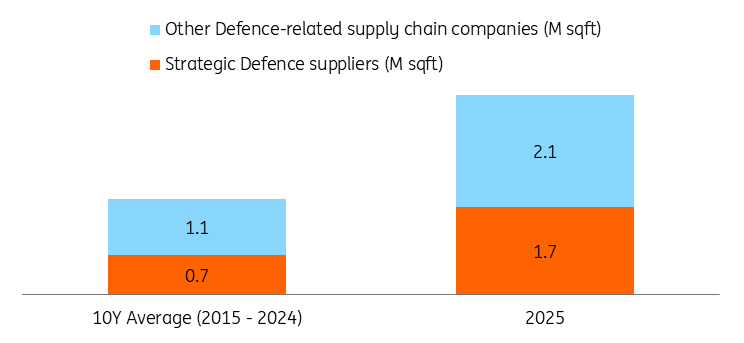
Defence spending is starting to have an impact. In the UK, defence manufacturers and their supply chains accounted for 3.8 million square feet of industrial and logistics leasing in 2025, around 8.5% of total leasing. This is nearly double the average of around 1.8 million square feet per year in the decade between 2015 and 2024, as defence companies are growing their share of industrial and logistics space.
Leasing of industrial and logistics space by defence-related companies in the UK
Defence-related companies are increasing their take-up of real estate space
In Europe, demand is also emerging. Sirius Real Estate, an industrial and business parks operator in Germany and the UK, announced it is targeting €1bn in defence investments in Europe over the next 18 months. As part of this strategy, it has acquired a €100m business park in Kiel, Germany, that is mostly let to Rheinmetall, the German defence group. Other investors and landlords, including Deka Immobilien, CTP and VGP, have noted increased activity from defence manufacturers and suppliers.
Research suggests the future impact will be meaningful. Savills estimates an optimistic level, noting that if NATO members converge to the 3.5% defence spending target over seven years to 2033, this could generate an additional 37 million square metres of industrial and logistics demand across Europe and the UK. This compares to the existing defence-related industrial and logistics space of around 35-40 million square metres. JLL estimates from the fourth quarter of 2025 show total existing industrial and logistics real estate inventory of around 400 million square metres, suggesting Savills’ estimate of 35-40 million sqm represents roughly 9-10% of the total. This seems quite meaningful, although estimates clearly vary by country and sector as well, and we treat this as an upside case, given the uncertainty around delivery mechanisms procurement timing.
Green Street, which is a bit more conservative, estimates around 26 million sqm of additional defence-related demand through 2035. Still, this would represent around 6.5% of existing stock.
AXA Investment Management and BNP Paribas Asset Management come up with estimates using a scenario of defence spending rising to 2.9% of GDP by 2030, which would create additional demand for 16 million sqm of industrial and logistics floorspace, representing around 4% of existing stock using JLL’s numbers. They also estimate this scenario would create 233,000 manufacturing and logistics-related defence jobs.
GARBE Industrial estimates the numbers specifically for Germany and estimates that demand for the institutional market and investors could correspond to around 2m to 4m sqm from 2025 to 2030. This is not a forecast from GARBE for Europe as a whole, but extrapolating this to Europe using Germany's share is also useful as a proxy. Using Germany’s annual take-up of around 5.3-5.4m sqm per annum, this would represent a potential uplift of 8-15% for Europe. Using c.11% as the midpoint, this approach suggests additional space demand across Europe of around 15m sqm by 2030.
Scenarios – how much additional demand could there be?
Studies take different views to come up with their numbers, but are useful as a guide. While the demand captured won't fully translate into new industrial and logistics demand for the institutional market, the potential opportunity is still significant. We compare demand forecasts with annual logistics take-up trends to provide a range of what defence spending could mean for landlords, developers and investors.
With annual logistics take-up averaging around 25m sqm per year across Europe in recent years, the potential share of annual take-up from the defence sector could rise to between 8-20%, with a base case of 14%. In the low demand scenario, an 8% uplift still represents quite a meaningful demand source, while the high scenario implies double-digit demand growth, comparable to the strongest years in recent times, including 2021 and 2022.
It is important to note that not all of this demand translates into additional leased space for investors and landlords. Most of the demand is expected to be delivered through build-to-own (BTO) or build-to-suit (BTS) bespoke facilities, reflecting the specialised, secure and strategic nature of defence-related real estate requirements. Research suggests that around 20-30% of the required new space will be leasehold, which translates into an annual institutional opportunity of 2% to 5% of take-up, which is still meaningful. In real terms, this means around 0.5m to 1.25m sqm of additional take-up per year coming from the defence sector.
Scenarios for incremental real estate demand
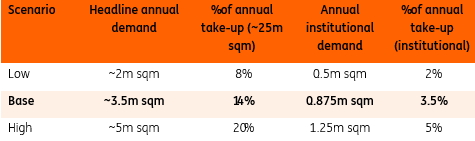
The numbers support the message that defence is a credible and growing source of demand, but a lot of uncertainty remains. Lead times are often quite long, and delays are the norm rather than the exception. The outcome of actual demand will also be dependent on the trajectory for defence spending and whether NATO targets are met within the expected timeframe – clearly, though, the data shows that defence spending could become a supportive incremental tailwind.
Three ways defence spending impacts real estate
1. More European (local) production
According to Bruegel, around 80% of defence purchases in Europe have historically been imported. The European Union proposes that countries should aim to procure at least 50% of defence needs from within the EU by 2030, rising to 60% by 2035. This is a strategic shift towards domestic production and reshoring.
Defence budgets are increasingly prioritising munitions, armoured vehicles, aerospace, drones and so on, which require specialised manufacturing space and adjacent logistics and industrial space. Academic research (from the IMF, for instance) shows that synchronised defence investment and procurement have historically led to strong domestic multiplier effects, such as increased economic activity. They also find that the effects tended to be larger when import intensity was lower and public investment efficiency was high – all factors that the EU is trying to achieve.
This is where the real estate link becomes tangible. More local production and manufacturing requires more space for assembly, storage, distribution and testing.
2. Expanded stockpiling and supply chain resilience
With the war in Ukraine and, more recently, the US-Iran war highlighting the need for higher inventory levels, just-in-time supply chains are less attractive for defence. NATO’s defence critical supply chain roadmap specifically highlights supply chain resilience and stockpiling as priorities. This could lead to structural demand for secure logistics and industrial space, often on very long-term leases, for the safe storage and distribution of stockpiles.
For instance, the EU Stockpiling Strategy announced in 2025 focuses on securing access to critical goods, such as pharmaceuticals, critical raw materials, or emergency and disaster response supplies. This should support demand for secure logistics space, often near military bases, ports, logistics corridors and transport links.
3. Increased infrastructure, R&D and tech spending
The 1.5% of GDP that will be spent on critical infrastructure and ensuring resilience and preparedness provides further stimulus for economic activity and could be a significant driver for structural demand for logistics and industrial real estate. For instance, the German government’s intention to exempt defence spending from budget control measures, alongside the €500bn fund allocated for infrastructure spending, is a good signal for the broader European defence industrial strategy, which could support logistics demand.
Furthermore, the defence sector is changing quickly in Europe. IISS notes that European defence start-ups have attracted over €2.4bn of venture capital since the start of the Russian invasion of Ukraine, with most of it raised since 2025. This heightened focus on R&D and innovation could support the need for spaces such as secure infrastructure, R&D parks, science parks, and mixed-use innovation districts, as well as more traditional logistics parks.
Where will the impact be largest?
While defence spending is rising across Europe, production is generally anchored in specific industrial ecosystems or hubs rather than spread evenly across the continent. As such, the impact is likely to be uneven and scattered.
Research shows that traditional regions such as southern England, Bavaria in Germany, Toulouse and Paris in France, and northern Italy will see the largest absolute increases in demand. GARBE estimates that roughly two-thirds of total demand potential will be allocated to Germany, France and the UK alone. Also, areas with meaningful defence R&D and specialised labour capabilities in countries such as the Netherlands, Sweden and Poland could see outsized demand growth.
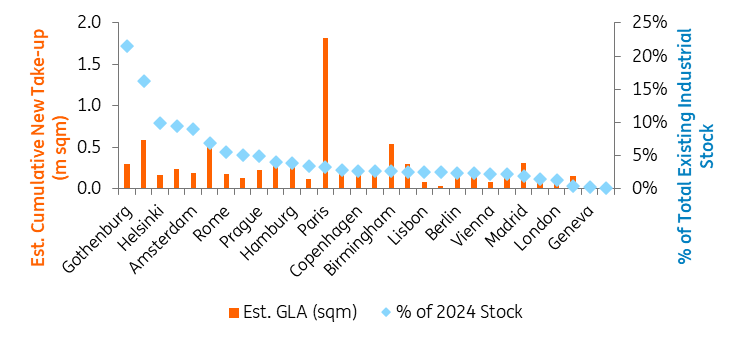
Data from Green Street shows that Paris could see the greatest estimated incremental demand from defence manufacturing through 2035, with around 1.8m sqm of estimated Gross Leasable Area (GLA). Munich, Milan and Birmingham are also set to benefit. When sized against existing industrial stock (as of 2024), Nordic markets in particular are likely to receive outsized demand for industrial and logistics. Gothenburg stands out, with 21% of incremental demand expected by 2035, with Munich, Helsinki, Stockholm and Amsterdam are all expected to see outsized demand as well.
Looking at less impacted markets, cities with smaller existing defence and related industry, such as Geneva, Brussels and Dublin, are unlikely to see any material impact.
The uneven race in the growing need for space
Estimated cumulative incremental space demand from defence-related sectors through 2035
No shock offensive, but a slow build-up
The defence theme is real, but it should not be overestimated. A large part of defence expenditures, such as pensions, personnel and so on, will not drive increased demand for space.
Timing is another constraint, as defence procurement cycles are often long and, in many cases, US defence companies will likely remain a preferred choice.
Also, defence-related capex for real estate is higher than standard industrial builds, due to the high level of specialist infrastructure, security approvals and safety buffers required for the defence sector.
Still, the demand story is there, with defence likely to become a solid and long-term demand anchor for the industrial and logistics property sector. 8% to 20% of take-up is expected over the next decade or so.
The bottom line – marching toward more demand
Defence spending is starting to become a new credible demand driver for Europe’s industrial and logistics property sector. This supports the broader reindustrialisation and could support the outlook for the sector as it contends with other headwinds.
The impact is set to be fragmented and unequally distributed, most likely concentrated in countries and regions with large existing defence-related industrial bases and markets with existing defence and R&D ecosystems.
Nonetheless, the broader trend should not be underestimated. The war in Ukraine and tensions in the Middle East, combined with a more fragmented and multipolar world, are reshaping how governments – including the EU and the UK – and companies are thinking about defence capabilities, supply chain resilience, and domestic production. Over time, this will likely drive structural demand. While it is not a logistics demand boom, defence-related demand for space is likely to become a relevant and durable theme for the sector.
Content Disclaimer
This publication has been prepared by ING solely for information purposes irrespective of a particular user's means, financial situation or investment objectives. The information does not constitute investment recommendation, and nor is it investment, legal or tax advice or an offer or solicitation to purchase or sell any financial instrument.Read more