Dutch factory-built housing faces looming overcapacity
- 13 November 2025
- Real estate Manufacturing, Construction and Retail The Netherlands
In the coming years, rising industrialisation in Dutch serial housing construction may lead to overcapacity. This could put pressure on the profit margins of industrial builders – and the least efficient, often smaller industrial construction companies, will not all make it

Productivity lags behind
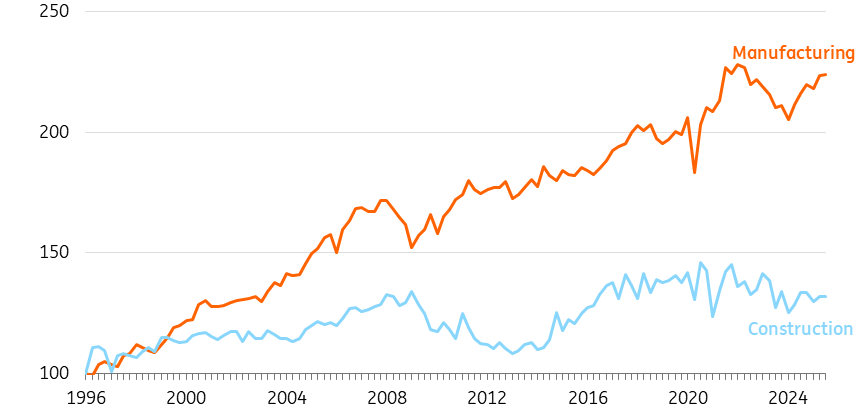
Labour productivity in the Dutch construction sector has been growing less rapidly than in other Dutch sectors for decades. While manufacturing has more than doubled its productivity since 1996, this growth in construction has remained at around 30%. This has led to rising construction costs, making it more difficult to achieve social goals such as sustainability and housing.
Labour productivity in the construction sector lags behind
Dutch labour productivity measured as the value added per worked hour (Index 1996=100), latest data point 3rd quarter 2025
Low productivity as a price driver
The limited productivity growth in construction means that the amount of labour needed to produce something within the sector is declining at a slower rate than in other sectors. Because wages in construction are rising, construction costs are rising faster for clients and consumers. Industrial companies are better able to absorb the impact of higher wages on prices due to their higher productivity growth, while construction companies are largely forced to pass this on to their customers.
Staff shortages smaller than in other sectors
While staff shortages in construction are a major problem, the figures demonstrate the sector's ability to cope somewhat better with the high demand for labour relative to other sectors. In 2025, an average of 20% of Dutch construction companies were unable to carry out all their work due to a lack of staff. This is considerable – but it's still much lower than in sectors such as IT, hospitality and industry, and the average of Dutch businesses (35%).
Construction companies are also succeeding in expanding their workforces. The number of people employed in Dutch construction rose from 448,000 to 594,000 between 2015 and 2024. Indirectly, the construction industry also benefits from productivity gains in manufacturing, for example. The number of employed persons there fell in the same period. These are often technically trained staff who sometimes move on to work in construction.
Labour shortages relatively small in Dutch construction
% Dutch companies with limited production due to labour shortages (average 2025)

Nevertheless, increasing labour productivity in construction also remains essential. An additional 20% productivity growth could reduce Dutch demand for construction workers by more than 100,000 people, making the sector less vulnerable to future shortages.
Industrialisation offers opportunities, but also risks
In recent years, many construction companies have invested in digitalisation and industrial building concepts, such as prefab and modular construction. Many relatively small companies have started up that produce about 50 to 100 homes industrially per year. This has led to higher labour productivity in new residential and commercial buildings in particular.
Nevertheless, the sector as a whole (including the infrastructure sector and specialised construction) is lagging behind, partly due to the large variation in projects, which makes standardisation difficult. The volatility of demand, local regulations and the high share of renovation and maintenance – where industrialisation is less applicable – also make industrialisation difficult.
Overcapacity threatens due to wave of industrialisation
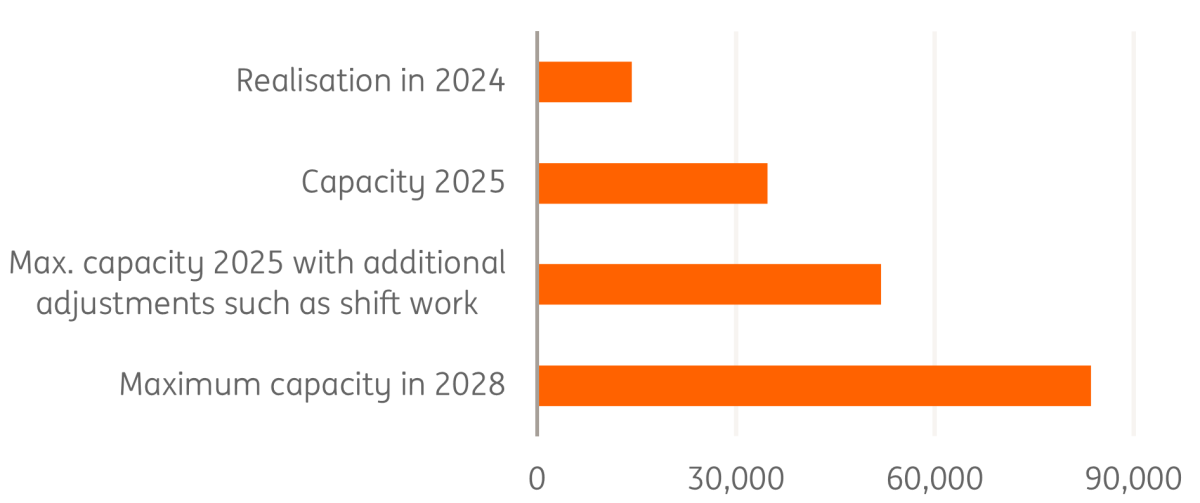
The wave of industrialisation also has a downside. The maximum Dutch industrial construction capacity is set to rise to more than 80,000 homes per year by 2028, although it remains to be seen whether the number of homes actually built will significantly exceed the current number of around 70,000. Not every new-build home is suitable for industrial construction, either, and this poses a risk of overcapacity.
Capacity for industrially built homes is increasing significantly
Industrial completion and (planned) annual housing capacity for the Netherlands as a whole
Increasing price pressure
Overcapacity in industrialised construction leads to fierce price competition and pressure on margins, which can jeopardise the continuity of companies. We believe that it will primarily be smaller industrial builders, whose higher costs stem from limited economies of scale, that face the greatest risk of not making it. Frontrunners who focus on digitisation and industrialisation and can scale up will temporarily benefit from lower costs and higher margins. But as soon as more companies follow suit, prices will fall sector-wide and the extra profits will disappear. House prices also don't have to fall because landowners and project developers "skim off" the cheaper construction costs by raising land prices.
However, building efficiently and investing in industrialisation and digitalisation are essential for any construction company to remain competitive and future-proof. This offers opportunities to increase productivity, absorb staff shortages and limit price increases.
You can find the full version of this study in Dutch here.
Content Disclaimer
This publication has been prepared by ING solely for information purposes irrespective of a particular user's means, financial situation or investment objectives. The information does not constitute investment recommendation, and nor is it investment, legal or tax advice or an offer or solicitation to purchase or sell any financial instrument.Read more