CIS-4: new global scenarios further reshape the outlook
- 16 April
- Armenia Azerbaijan
The upside to energy prices further reshapes our CIS‑4 view. Exporters benefit more, gold provides Uzbekistan with a unique buffer, while importers face cost pressures. Meanwhile, FX stability is retained region-wide thanks to continued capital inflows amid a prudent monetary policy approach


Energy exporters benefit the most
Another upward revision to global energy price assumptions calls for an adjustment of our CIS‑4 outlook. The base case scenario for Brent is now $89/bbl for 2026 and $77/bbl for 2027, but the adverse scenarios assume $121 and $97, respectively.
Azerbaijan and Kazakhstan are the beneficiaries. Given our assessment of the sensitivities, the new base case makes Azerbaijan the biggest winner, with its 2026 current account reaching 8-9% of GDP and budget surplus at 4.0-4.5%. Kazakhstan’s financial gain could be limited by dividend outflows and lower investment income of the sovereign fund, but the current account deficit should nearly halve to 2.0-2.5% of GDP in 2026, while the consolidated budget should remain close to balance.
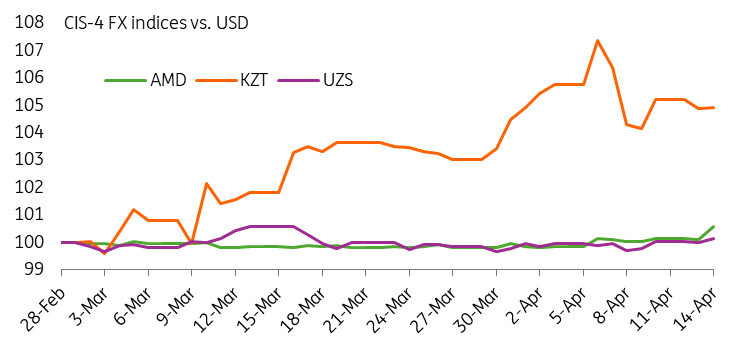
Commodity importers face a less favourable environment. Armenia’s current account deficit should widen to around 9% of GDP in 2026, with the fiscal deficit remaining in the 3-4% GDP range. That said, the adjustment costs have so far been absorbed without destabilising domestic markets. The Armenian dram has remained resilient since the outbreak of the Iran war, indicating that capital flows and remittances continue to provide an effective buffer.
KZT has rallied on higher oil, but non-oil FX have remained resilient
Uzbekistan could withstand a return to gold prices of $2.0-2.5ths/oz
Uzbekistan is a special case due to its exposure to gold. ING’s base case for gold has so far remained unchanged, but in an adverse scenario, gold prices are vulnerable to downside risks. Uzbekistan has the capacity to mitigate gold price volatility through export volumes. The country exported around 85 tonnes of gold in 2025, but Uzbekistan has previously demonstrated the capacity to temporarily increase export volumes to around 120 tonnes per year, as seen in 2023.
This implies that even if the gold price were to average $2,200/oz in 2026, roughly 35% below the 2025 average, Uzbekistan could still maintain annual gold export proceeds of around $10bn by boosting volumes.
Common risk of higher CPI calls for tighter monetary policy approach
Higher commodity prices reinforce inflation risks across the CIS‑4, particularly through the food channel. Armenia is especially sensitive, with a 10% increase in global food prices (UN FAO) potentially adding up to two percentage points to CPI, though other CIS-4 are also sensitive at 0.8-1.5 ppt.
Given the limited nature of the food price increase, we have made only a modest c.0.5 ppt increase in our CPI forecasts for most of CIS-4, with the main effect delayed until 2027. However, the potential second-round effects still call for a more cautious approach from the central banks. All the CIS‑4 central banks, including those in Kazakhstan and Uzbekistan, tightened the wording of their monetary policy in March. We still do not expect any rate hikes in 2026-27, but the room for rate cuts in CIS has been reduced.
Longer-term investment depends on domestic institutional framework
Looking beyond the commodity repricing, structural considerations remain decisive for the region's investment case. Domestic and foreign policy, the role of the state, sectoral diversification, and the institutional environment remain common challenges across the region. Country-specific macro themes also matter. Kazakhstan and Uzbekistan could support portfolio inflows through sustained fiscal discipline and firmer control over inflation; Azerbaijan would benefit from a more open capital account; and Armenia would gain from a more secure and predictable foreign policy position in the region.
Overall, it would be a stretch to view CIS financial assets as a direct alternative to developed markets currently experiencing pressure on their financial assets. However, tactically they can match the interests of investors seeking higher returns and domestic issuers – mainly sovereign and quasi-sovereign, as seen in Uzbekistan recently – looking to secure financing at attractive valuations.
Content Disclaimer
This publication has been prepared by ING solely for information purposes irrespective of a particular user's means, financial situation or investment objectives. The information does not constitute investment recommendation, and nor is it investment, legal or tax advice or an offer or solicitation to purchase or sell any financial instrument.Read more

Included in the following bundle

ING Monthly: The world waits for a climbdown
- This bundle contains 13 Articles