Belgium’s housing supply–demand mismatch widened further in 2025
- 7 April
- Manufacturing, Construction and Retail Belgium
Belgium saw another decline in building permits in 2025. Residential construction also continued to weaken, driven by a sustained downturn in apartment projects, further widening the mismatch with rising future demand for smaller housing units. Despite early signs of stabilisation, a strong rebound in permits appears unlikely in the near term

The decline in permits continued in 2025
The number of building permits issued in Belgium continued to decline in 2025, in line with the downward trend of recent years. The total number of permits remained 3% lower than in 2024, following previous declines of 9% in 2023 and 8% in 2024.
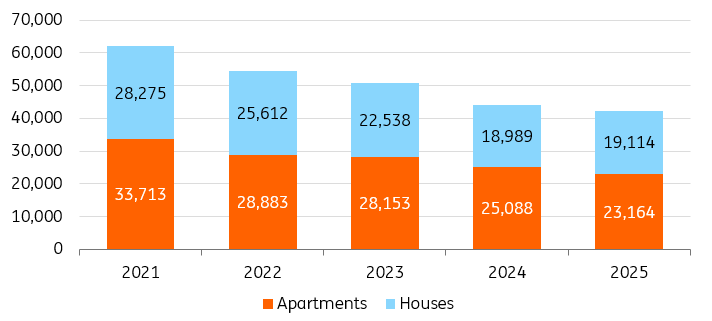
The decline also continued in residential construction, with permits falling by a further 4% in 2025 compared to the previous year. A notable development is the divergence between permits for houses and apartments. While the number of permits for houses fell sharply in 2023 (‑12% YoY) and 2024 (‑16% YoyY), it increased slightly again in 2025 (+0.7% YoY). For apartments, by contrast, the decline accelerated: after a modest fall in 2023 (‑2.5% YoY), the number of permits dropped much more sharply in 2024 (‑11% YoY) and again by almost 8% YoY in 2025. As a result, the proportion of apartments among total housing permits was lower in 2025 at 55% than in previous years (56% in 2023 and 57% in 2024).
Residential permits fell further in 2025 as apartment construction weighed on activity
This evolution contrasts sharply with demographic trends. The Federal Planning Bureau estimates that around 422,500 additional households will be formed by 2040, 71% of which will consist of single‑person households. This corresponds to a 16% increase in the number of single people by 2040 compared with 2025. However, our current housing stock (in terms of the number of housing units) still consists largely of houses (69%) and thus remains house-dominated. As a result, additional smaller, more affordable housing units, predominantly apartments, will be needed to meet rising demand and prevent a growing mismatch in the housing market.
A strong rebound seems unlikely in the near term
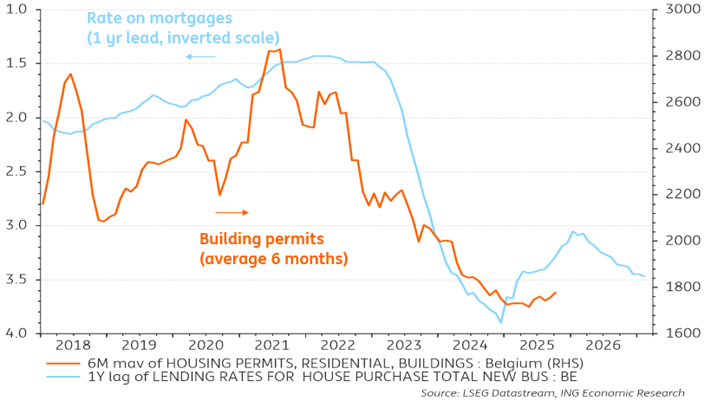
While there are, for the first time, signs that the years-long decline in building permits is beginning to bottom out, this should certainly not be interpreted as a normal recovery for the construction sector. Overall permit levels remain at historically low levels, partly due to weak demand for new‑build housing and complexes and slow permit procedures. Moreover, the decline in interest rates in 2024 proved insufficient to meaningfully stimulate construction activity, and in 2025 interest rates stabilised before edging up again.
Looking ahead, we expect a slight upward trend in interest rates over the coming years, suggesting a strong rebound in building permits is unlikely for the time being.
Decline in building permits seems to be bottoming out, but rising mortgage rates offer little stimulus
Content Disclaimer
This publication has been prepared by ING solely for information purposes irrespective of a particular user's means, financial situation or investment objectives. The information does not constitute investment recommendation, and nor is it investment, legal or tax advice or an offer or solicitation to purchase or sell any financial instrument.Read more
