Belgian real estate market will shift to a lower gear after a strong 2025
- 30 April
- Belgium
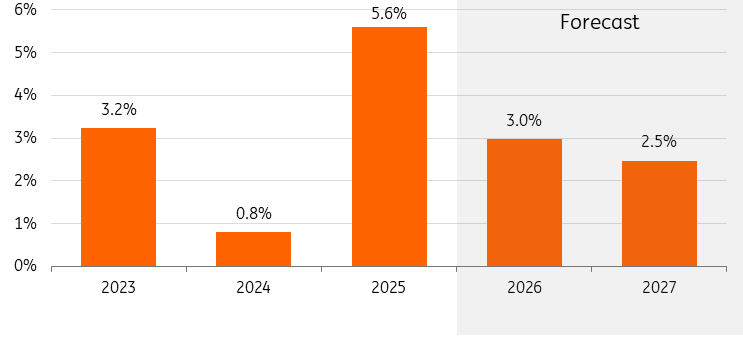
2025 was a strong year for the Belgian residential real estate market, with median price growth of 5.6% year-on-year for existing homes. Looking ahead, higher interest rates, slower economic growth and weaker purchasing power growth are expected to moderate dynamics in 2026 and 2027, with prices rising by 3.0% and 2.5% respectively


Strong price growth in 2025 supported by regulatory changes
In 2025, median housing prices for existing homes in Belgium rose by 5.6% year-on-year, continuing the recovery that started in late 2024, despite slightly higher long-term interest rates. Buyers nevertheless returned to the residential real estate market as demand was supported by policy measures that improved affordability. Registration fees for the sole family home were reduced in both Flanders (-1 percentage point) and Wallonia (-9.5 percentage points). As these fees are a one-time cost that usually cannot be financed through a mortgage, the measure immediately lowered the financial barrier to purchase.
Existing homes with poor energy performance also became more attractive. In Flanders, the renovation requirement was relaxed and the obligation to move toward EPC label A was abolished, reducing the renovation effort needed to reach at least EPC label D and lowering estimated renovation costs. In addition, the extension of the reduced 6% VAT rate on demolition and reconstruction further strengthened the appeal of existing homes compared with new construction, which remains subject to 21% VAT.
The National Bank of Belgium has also shown that homes with poor energy scores have become relatively cheaper in recent years. Combined with looser regulations, this created opportunities for buyers of existing properties. The new construction sector, by contrast, remained under pressure in 2025, with a historically low number of building permits. However, there were initial signs that the decline in building permits was beginning to bottom out, a move confirmed in January 2026. This year started stronger than last year, with an 11% increase in housing construction permits compared to January 2025.
Real estate outlook 2026 and 2027: from strong rebound to moderation
After the strong momentum seen in 2025, we expect the real estate market to become less dynamic in the coming years. Slightly higher long-term interest rates, slower economic growth and weaker purchasing power growth are likely to weigh on activity. Although notary data suggest that 2026 got off to a strong start, this might partly reflect statistical timing effects. Transaction figures are recorded when the notarial deed is signed, not when the sales agreement is concluded. As a result, early‑2026 data includes many transactions that were decided upon in 2025.
Meanwhile, underlying indicators already signal a slowdown this year: the number of new mortgages fell by 14% year-on-year in the first three months of 2026 compared to the same period in 2025, usually a leading indicator of transactions and price dynamics. Against this backdrop, we expect median prices for existing homes to rise by 3.0% in 2026 and 2.5% in 2027, clearly more moderately than in 2025.
Evolution of nominal median prices for existing properties, including forecast ING
Content Disclaimer
This publication has been prepared by ING solely for information purposes irrespective of a particular user's means, financial situation or investment objectives. The information does not constitute investment recommendation, and nor is it investment, legal or tax advice or an offer or solicitation to purchase or sell any financial instrument.Read more
