First-quarter GDP miss in the Philippines signals weaker 2026 outlook
- 7 May
- Philippines
First-quarter GDP growth fell well short of expectations, weighed down by weak consumption, contracting investment, and a drag from net exports despite a modest pickup in government spending. The data reinforce downside risks to the 2026 growth outlook, even as the central bank remains focused on inflation rather than growth support

1Q GDP misses estimates
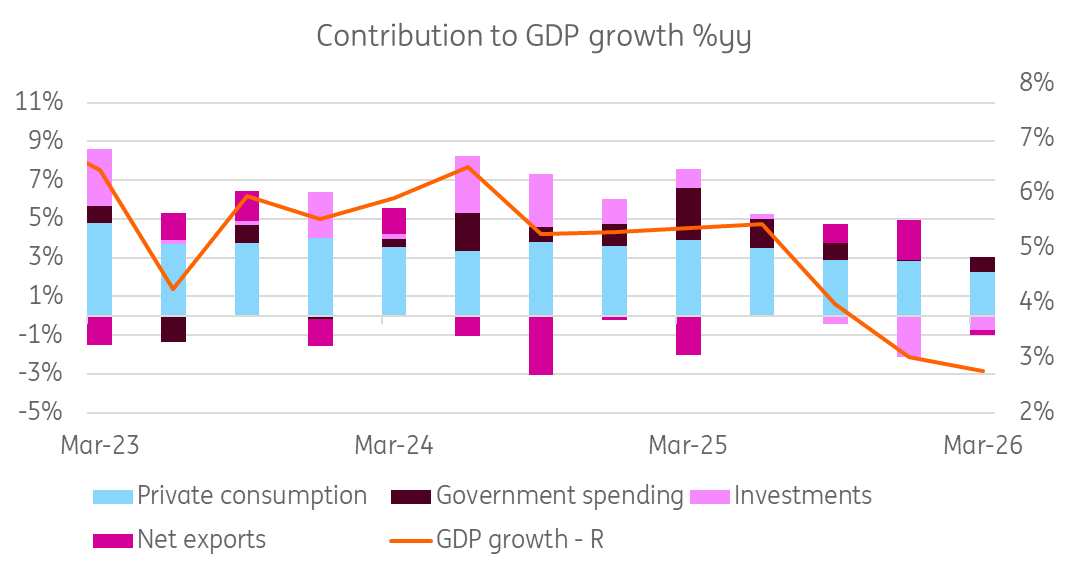
First-quarter GDP growth of 2.8% year-on-year was a significant disappointment, coming in well below both our forecast and consensus expectations of 3.3% year-on-year. Domestic demand remained weak. Private consumption growth slowed to 3% year-on-year, representing not only a further decline relative to the previous quarter, but also the weakest reading since the Covid period. Even at this subdued pace, private consumption accounted for roughly 80% of total GDP growth, underscoring how significantly weaker other growth components were.
Private investment continued to contract on a year-on-year basis, while net exports also shifted to a negative contribution. Goods import growth accelerated to around 7% year-on-year, while goods export growth moderated to 13% year-on-year, resulting in a net drag on growth. Services exports, growing at 3% year-on-year, remained relatively resilient.
Government spending increased by 4.8% year-on-year, up sharply from 0.7% in the previous quarter, contributing 0.8 percentage points to GDP growth. While this points to some nascent signs of recovery, the overall impulse remains modest. Overall, we believe government spending will need to increase more meaningfully for second-round effects on consumption and investment to materialise. Recent data suggests that rising unemployment and sharply elevated inflationary pressures are likely to keep private consumption suppressed, as households boost precautionary savings.
Taken together, today’s GDP release points to a much weaker-than-expected growth trajectory for 2026, increasing the downside risks to our already below-consensus GDP growth forecast of 4.5% YoY (consensus 4.8%). We do not believe this weak GDP print will deter the BSP from proceeding with a rate hike in June. The central bank has recently reasserted inflation control as its primary objective, while downplaying the role of monetary policy in cushioning near-term growth risks – particularly as the current slowdown appears largely driven by a deceleration in government spending rather than monetary conditions.
Contribution to Philippines GDP growth
Content Disclaimer
This publication has been prepared by ING solely for information purposes irrespective of a particular user's means, financial situation or investment objectives. The information does not constitute investment recommendation, and nor is it investment, legal or tax advice or an offer or solicitation to purchase or sell any financial instrument.Read more