Europe proves it can act strategically as India deal seeds future growth
- 28 January
- India Trade
European trade negotiators have finally found the fast lane. India and the European Union concluded a landmark agreement after nearly two decades of on-and-off talks. The deal marks another major step in the EU’s push towards more strategic independence

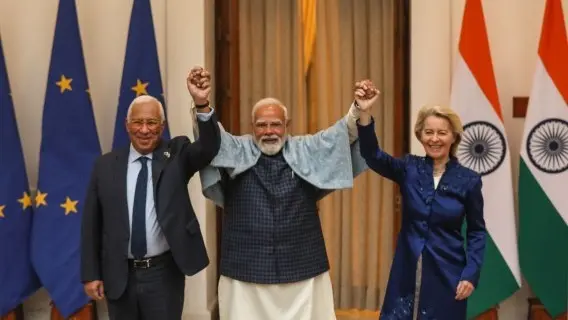
The EU is chasing autonomy one deal at a time
Just two weeks after the Mercosur deal was finally signed, following more than 25 years of negotiations, the EU concluded another major trade agreement nearly two decades in the making. During a brief visit to India, European Commission President Ursula von der Leyen finalised negotiations for the “mother of all deals”, as she nicknamed the EU-India free trade agreement.
The EU, the third-largest internal market (after China and India), has now entered a trade agreement with one of the world’s largest economies, with more than 1.4 billion people and a GDP of approximately €3.4 trillion. Currently, India is the EU's ninth-largest trading partner by total trade in goods.
Trade imbalance: a gap the EU hopes to narrow
EU trade with India in € billion; *2025 projection
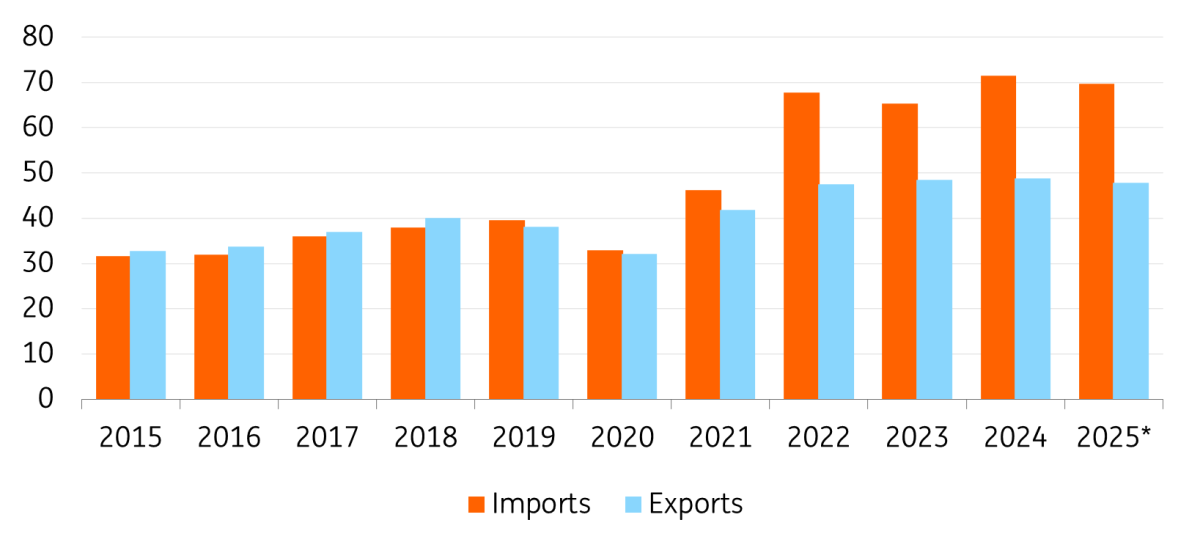
According to the European Commission, this deal would double the value of EU goods exported to India by 2032 by eliminating or reducing tariffs on 96.6% of exports. Overall, tariff reductions will save around €4bn in duties on European products each year. While EU exports increased until 2023, momentum has since flattened. However, the EU imports far more from India than it exports, accounting for more than 17% of India’s total exports.
Fast paced agreement with broader scope
The EU will be granted much larger tariff reductions than any other trading partner. Tariffs on cars will gradually decrease from 110% to 10% over the next five years. Levies on car parts will be eliminated within five to 10 years. Tariffs on machinery, chemicals, and pharmaceuticals, which can reach 44%, will be mostly eliminated; exact reduction schedules have yet to be clarified. The EU will eliminate or reduce tariffs on 99.5% of goods imported from India within seven years.
The agreement will include additional details on a new security partnership and other benefits, such as privileged access for EU companies to the Indian services market. Additionally, a memorandum will be included to establish an EU-India platform for cooperation and support on climate action, to help India reduce its greenhouse gas emissions.
Open doors, but a difficult market for European carmakers
From an EU perspective, the agreement secures far more favourable terms than India offers other trading partners. New Delhi agreed to allow up to 250,000 vehicles manufactured in Europe to enter the country at preferential duty rates per year. This is more than six times larger than the 37,000-unit limit of the deal India recently closed with the United Kingdom.
Although the agreement could present a significant opportunity for European car manufacturers, given the market's potential, we anticipate that any benefits will take some time to materialise. The Indian car market is dominated by well-established Japanese brands such as Suzuki and Hyundai, which together account for more than 50% of the total market. It certainly won't be easy for European carmakers to penetrate the Indian market, given that they currently have a market share below 3%.
Brussels still needs the final stamp
As the Mercosur deal showed, it’s important not to be overly optimistic just at the moment of trade deal agreements. Ratification and implementation can be cumbersome processes. The pact is expected to be formally signed after legal vetting, a process that could take several months. Once the Council has adopted the agreement, the EU and India can sign it. Next, it will require the European Parliament's consent before it can be applied. Swift action on this side would send a strong signal to trading partners that the EU is capable of closing and implementing a trade deal without further issues.
If ratified, the EU-India trade agreement will be one of the most significant economic partnerships that the European Union has ever concluded. After two decades of stalled talks, the sudden breakthrough proves that Europe can act decisively when pressure is really on. Put together with Mercosur, the India deal will bring only minor economic relief and benefits in the near term. But they open the door for future growth and show that Europe can actually act strategically. That’s despite these two trade agreements suggesting Europe still mainly banks on its export-driven growth model. It’s a risky strategy as industrial competition from China is very present in the Indian market.
Yet 2026 is emerging as the year when Europe will need to demonstrate how much resilience and strategic autonomy it is willing – and able – to build. In this regard, the first weeks of the new year have been promising. Ratification troubles surrounding the Mercosur deal show that some aren’t hearing the wake-up calls. Even so, these two trade agreements should be only the beginning of the EU’s drive to strengthen its autonomy and resilience.
Content Disclaimer
This publication has been prepared by ING solely for information purposes irrespective of a particular user's means, financial situation or investment objectives. The information does not constitute investment recommendation, and nor is it investment, legal or tax advice or an offer or solicitation to purchase or sell any financial instrument.Read more