‘Go your own way’, sing Lagarde and Powell
- 9 October 2025
- United States
Monetary policy on both sides of the Atlantic is currently dancing to the tune of an old Fleetwood Mac track


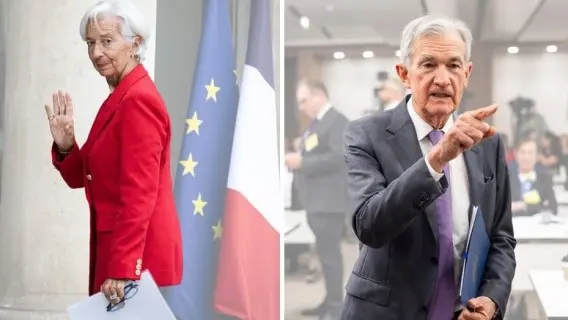
Remember when former ECB President Jean-Claude Trichet coined the phrase, 'a very strong brotherhood of mutual admiration?' He was talking about his fellow central bankers. Don't be fooled that this remains a cosy club. Mutual respect may well be there. And while there's a lazy assumption that the European Central Bank simply follows the Fed, it really has become something of an urban legend. True, until the financial crisis, it did look a bit like that. But between 2014 and 2020, central banks went their separate way. And we're seeing that again right now; it's a separation that looks set to continue.
While the ECB has made itself comfortable in a ‘good place’, with inflation settling down at around 2% and growth expected between 1% and 1.5%, the Fed has just restarted its rate-cutting cycle. So, we've got monetary policy inactivity in the eurozone and rate cuts in the US. If anything, we have the US Federal Reserve following the ECB, not the other way around.
Why we're looking at 4 more Fed rate cuts
Below the surface of a strong US economy in the second quarter – inflation at 3% and stock markets at all-time highs – risks to the Fed’s dual mandate of price stability and maximum employment are shifting. Recent payrolls numbers and subsequent downward revisions led the Fed to acknowledge that the jobs market no longer looks “solid." The government shutdown is restricting official data flows, but private sector indicators suggest that the 'low hire, low fire' economy could become a “no hire, let's fire” market.
At the same time, the inflationary threat from tariffs has not materialised as quickly as feared. The average tariff rate is estimated to be around 18% based on announced country and sector rates, but collected customs revenues imply a realised rate closer to 10%. Companies are seemingly absorbing this cost increase for now. This provides more time for disinflationary pressures from falling energy costs, weakening housing rents and slowing wage costs to offset the tariff impact.
A weaker jobs backdrop, coupled with lower-than-expected inflation, justifies moving interest rates down towards neutral and leaves us forecasting October and December interest rate cuts, with a further two 25bp cuts in the first half of next year.
Don't rule out another ECB cut
Contrary to the Fed, the ECB has already brought interest rates towards neutral. And while ECB officials want to make markets believe that the rate cut cycle is over, we still see a chance of at least one more rate cut. If the ECB’s own rather benign forecasts for growth and inflation turn out to be too optimistic, the ECB could be forced to fine-tune its monetary policy stance. In such a scenario, roles between the two brothers (or sisters), leader and follower, would be switched again.
But in our base case scenario, we see the Fed and the ECB dancing to the tune of the old Fleetwood Mac song ‘Go Your Own Way’. Something they have been doing much more often than many markets think.
Content Disclaimer
This publication has been prepared by ING solely for information purposes irrespective of a particular user's means, financial situation or investment objectives. The information does not constitute investment recommendation, and nor is it investment, legal or tax advice or an offer or solicitation to purchase or sell any financial instrument.Read more
Authors


Included in the following bundle

ING Monthly: Europe prays that France gets a grip
- This bundle contains 16 Articles